


From time to time on our spiritual journeys, we should ask ourselves serious questions about our commitments to Christ, questions which require honest answers 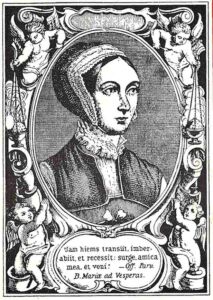 even if we answer them only in the silence of our hearts. Here is a challenging question for a believing Catholic:
Would you allow a priest to say Mass in your home if it meant you could get the death penalty if caught? It’s a tough question, isn’t it?
The reason I pose it is because I’m about to tell you the story of a woman who did take that risk—and her fate was exactly as the question suggested. The woman’s name was Margaret Clitherow of York, England, and her story is as beautiful as it is tragic.
Martyrdom and Glory
The hard part about martyrs is that, by definition, they lose their battles. They are killed, and often their deaths are cruel beyond belief. Their own contemporaries usually label them insane, yet, the Church celebrates them and holds them up to us as role models for the rest of us. There’s our Church being paradoxical again. It seems to be an institutional trait.
But to be clear, the Church doesn’t celebrate craziness as such. I know a good many fairly crazy Catholics who I would not hold up as role models (some people would include me in this category, but I’m taking the Fifth). Being a fool is not a virtue, but being a fool for Christ—an actual category of sainthood in the Eastern Churches—is sometimes the greatest virtue.
Please never forget that one story in Mark’s Gospel, mentioned almost in passing, where Jesus’ own relatives thought that He was acting a bit, well, crazy:
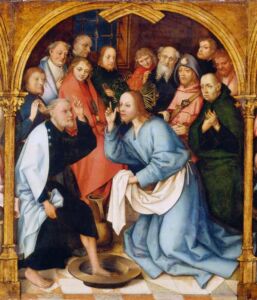 The crowd gathered, making it impossible for them even to eat. When his relatives heard of this they set out to seize him, for they said, “He is out of his mind.” (Mk 3:20-21).
Did you know that Jesus’ extended family thought He was insane? The religious leaders were not too fond of Him either: “He is possessed by Beelzebul,” they said.
So much for Jesus’ track record of social respectability. I can’t say I’ve ever heard a sermon on this rather important but disagreeable aspect of Jesus’ family life.
The Church, at least, recognizes many saints throughout history who were considered foolish by their contemporaries and who did things that were generally thought to be too risky for most people to chance.
Their total fidelity to Christ in times of persecution is one of those things our Church celebrates, and some of our greatest saints show us the value of such a risk.
The Pearl of York
Margaret Clitherow (1556-1586) is one such saint. She was given the name “The Pearl of York” only after the Church had time to reflect upon her death. Before her death, virtually everyone thought she was crazy. And in gratitude for her fidelity to Christ, her countrymen crushed her to death with 800 pounds of stone. She was only 30 years of age. To make matters worse, St. Margaret was the mother of three young children.
The form of her torture was utterly excruciating. She was made to lie down on a sharp rock about the size of a baseball, and her hands were stretched out and tied to stakes. A door was placed over her (ripped from her own home) and the weight was gradually increased until the pressure on her body lying between the boulders on 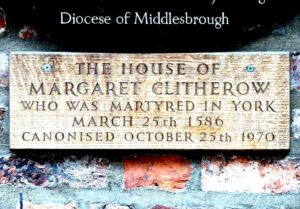 top and the unyielding rock below broke the spine. It took her fifteen minutes to die in that state.
Margaret was also pregnant with her fourth child at the time, but, astonishingly, that was of no consideration to her persecutors. You may remember the story about the martyrdom of Sts. Perpetua and Felicity. Felicity was also pregnant, but the pagan Roman persecutors at least had the humanity to let her to give birth before they executed her.
What kind of diabolical mind, I ask you, even thinks of doing something like that to another human being, let alone another Christian? The rabid English hatred of the Roman Catholicism was so deep that they stooped lower than the pagans in their merciless killing of Catholics.
Rampage against Christ’s Church
Margaret Clitherow’s death takes place in a wider context. After King Henry VIII had Parliament declare him head of the Church in England in 1534, something that 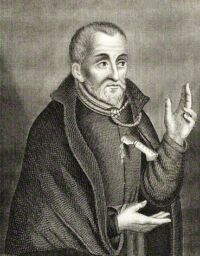 had never happened before in 1500 years of Christianity, Catholicism became the subject of a brutal persecution that lasted close to a hundred and fifty years (1534 to 1681).
Only the Roman persecutions of the early Church lasted longer, but those were sporadic. The English persecution was an effort to completely exterminate every vestige of Catholicism in the land, which was ironic because it happened to be the ancient Faith of England. (Left: St. Edmund Campion)
One of the most celebrated Catholic martyrs of England was the Jesuit priest, Edmund Campion, who asked at his sham trial why he was being condemned for things the whole English nation had believed for a thousand years. No one ever answered that question.
Timeline of Persecution
The timeline of the persecution of Catholics in the 1500s reads like a repellent roller coaster ride where the only winners were tyrants and the cruelest opportunists:
- In 1534 Parliament enacted the Act of Supremacy and declared Henry VIII the Head of the Church. High-profile martyrdoms from this first wave of persecution were St. John Fisher (the only bishop in England to remain faithful to Rome), St. Thomas More, and a whole community of English Carthusian priests.
- Then, between 1536 and 1541, Henry and his cronies of the English nobility stole every single piece of Catholic Church property in England (some 900 religious houses and monasteries), including the great cathedrals.
- Henry VIII”s daughter, Queen Mary, reigned for five years (1553-1558) and attempted to bring back Catholicism by repealing her father’s wicked acts (the Statute of Repeal in 1554), but
- Her half-sister, Elizabeth I, subsequently usurped the throne and had her sister Mary put to death in 1558 (though the sanitized accounts just say she died of cancer). She abruptly ended England’s official attempts to return to its Catholic roots.
- That same year, Parliament passed the (Second) Act of Supremacy and the Act of Uniformity, which were the death blow to any thoughts that Catholics would be let off the hook of persecution. In fact, the brutal persecution that followed swept up Margaret Clitherow and hundreds of clergy, religious, and laity into a tsunami of holy blood.
The Recusants
The Catholics who refused to agree to the wholesale scouring of their religion from the soil of England were called “recusants,” a term the Oxford English Dictionary defines this way:
A person, esp. a Roman Catholic, who refuses to attend the services of the Church of England. More generally: a religious dissenter.
The recusants paid heavily for their fidelity to Christ and His Bride, the one, holy, Catholic, and apostolic Church. Margaret Clitherow’s great offense, for example, was harboring priests who would come and say Mass for the beleaguered Catholics remaining faithful to Rome. Some she hid in her home but most she housed in a local hostel with false names and cover stories.
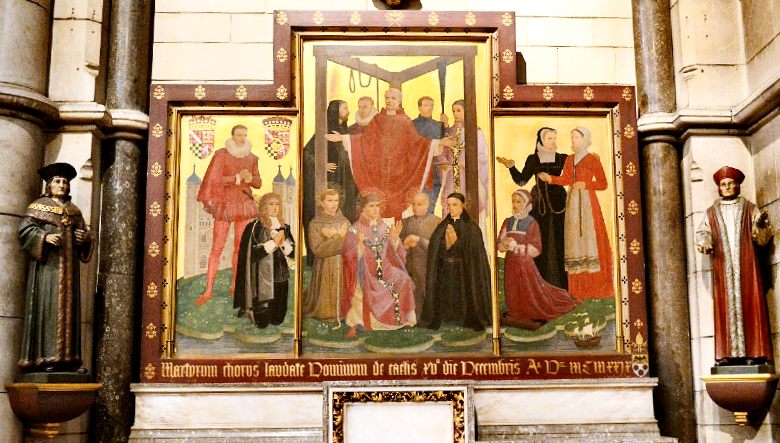
14 English Martyrs canonized in 1970. In fact, there were 15 martyrs, including the unborn child Margaret Clitherow (kneeling, right panel) was carrying. Statues of St. Thomas More (L) and St. John Fisher (R) flank the altarpiece.
The infamous Acts and subsequent anti-Catholic laws were absolutely draconian in nature. Among other things, they
- Forbade anyone from “maintaining the jurisdiction of the Pope”, proselytizing for Catholicism, or publishing any papal document or decree in England (under penalty of death);
- Required all churches in England to use the Protestant Book of Common Prayer for services (thus drastically altering and nullifying the Mass);
- Forced all citizens of the realm to attend services in the new Church of England;
- Forbade raising children with teachers who were not licensed by an Anglican bishop;
- Prohibited the harboring of Catholic priests (a death penalty offense) or attending Catholic Mass; and
- Made it punishable by death for a man to go overseas to be trained or ordained into the Roman Catholic Priesthood.
This is the cultural and political context in which tens of thousands of faithful Catholics operated. In this scenario, the “risk” factor should be quite evident.
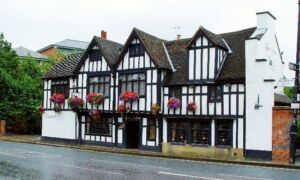
Black Swan Hotel where St. Margaret housed many of the clandestine priests.
The vast majority of recusants kept the Faith and incurred imprisonment, fines, the confiscation of property, loss of jobs, lawsuits, social ostracization, and bullying: kind of like the way conscientious objectors were treated during the COVID era in our country.
The anti-Catholic laws, though not uniformly enforced, were in effect from 1534 until 1820, the very end of the reign of King George III (every American knows about him). Only one anti-Catholic provision in English law remains on the books to this day: no Catholic can ever ascend to the monarchy. It assures that no Catholic could ever be the head of the Church of England. At lest they’re consistent.
As you might imagine, the overall effects of persecution were devastating: the Catholic Church became an underground church for 150 years, and the only saints created in England from 1535 until John Henry Newman’s canonization in 2019 were martyrs.
A Very Sweet Soul
St. Margaret Clitherow was one of those intrepid personalities that you want on your team when the going gets tough, but she also seemed to be a very sweet soul, rightly meriting the beautiful title of “pearl.”
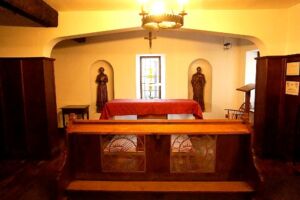 She especially loved the Catholic priests who were brutally martyred for the crime of saying Mass. She used to make pilgrimages to the local site of their martyrdom at night (a place called York Tyburn) and prayed for the grace of martyrdom like them, if it were to be God’s will.
(Left: Altar/Shrine inside Clitherow home.)
She was imprisoned numerous times and even spent a period of two years in jail for various violations, but when she was finally caught and convicted of a capital offense, she refused to say a word or even plead innocent in her defense. Any plea would have forced her children and other Catholics to testify against her in trial, and she could not allow that to happen. Recusant to the end. Her silence, in effect, convicted her and sentenced her to a horrible death.
Before she was tied up and ready to undergo the treatment, she was mocked by Anglican ministers who demanded that she confess her crimes. She would not: “No, no, Mr. Sheriff,” she replied, “I die for the love of my Lord Jesu.” Indeed, Jesus was on her mind to the last as she exclaimed: “Jesu! Jesu! Jesu! have mercy on me!”
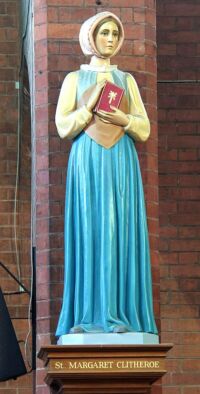 A Martyr’s Legacy
Her final free act was to voluntarily walk barefoot to her place of execution. She had left her shoes to her 12-year-old daughter as a symbolic exhortation for her daughter to “walk in her mother’s shoes.” Wow.
York’s pearl of great price had literally been crushed before the eyes of the world, but her legacy of heroism was not without effect. She lived in the hearts of her sons, Henry and William, who grew up and became Catholic missionary priests spreading the Catholic Faith. And her daughter, Anne, who inherited her mother’s shoes, became a nun—in exile in Louvain, Belgium.
Should we wonder why the Catholic Church celebrates martyrs?
———-
Photo Credits: Via Wikimedia: Portrait (1750, Stecher); Black Swan Hotel (Peter Church); Plaque-Shrine-House (Spudgun67); House (Tilman2007); House-Street Scene (Dmitrij M); Shrine Interior (Ian S); Martyrs Reredos (AndyScott); St. Edmund Campion (National Portrait Gallery, London); Statue of St. Margaret (English Martyrs Rodney Road, Walworth); Feature Rosary via Pexels.
[Note: This article is a reproduction of the Sacred Windows Email Newsletter of 2/8/26. Please visit our Newsletter Archives.]





.jpg)

.jpg)


Leave A Comment