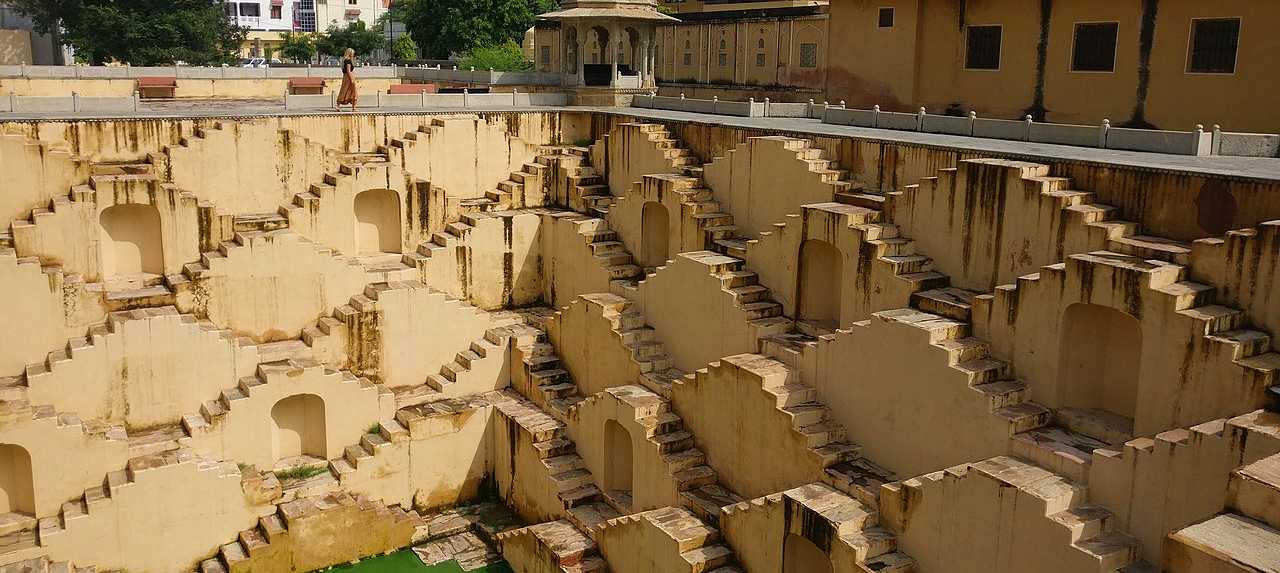
Sometime around the year 1800, the German mystic, Anne Catherine Emmerich, had a vision of Jacob’s ladder ascending to heaven. Here is how she described it:
Then I saw the ladder that Jacob beheld in his dream… It was rising up to heaven from Jacob, where he lay upon the earth. It was like a living genealogical tree…. I saw on it, Jacob’s descendants, one above another; they formed the ancestry of Jesus according to the flesh.… The holy Virgin in whom God willed to become man appeared on the highest point of the ladder touching the heavens. I saw heaven open above her and disclose the splendor of God. (Anne Catherine Emmerich, The Life of Jesus Christ, vol. 1, 90.)
I never imagined the biblical ladder was actually a genealogical tree, but then again, mystics always astound us with their insights. This amazing vision affirms that the ladder (or stairway) has been fixed in the religious imagination since the Book of Genesis.
The Theology of Ascent
Ladders and stairs are structures one can traverse both upwards and downwards. The scripture passage that speaks of Jacob’s ladder says that “God’s angels were 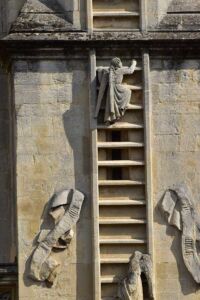 going up and down on it” (Gen 28:10–19; Jn 1:51), an image that Jesus later uses to indicate that He is the fulfillment of that Old Testament image.
(Left: Relief sculpture on Bath Abbey, UK, of angels climbing up Jacob’s Ladder.)
Jesus is the connecting point between heaven and earth. Angels come down from heaven to serve Him and man finds his way up to heaven through Him. Jesus, the one mediator between God and Man (1 Tim 2:5), had to open that pathway for us and provide for us the spiritual ladder to get there.
Although most staircases we know of are commonplace structures in houses and buildings and most ladders are instruments for work, they can metaphorically be sacred windows of a sort. Ladders and stairs are good examples of the Theology of Ascent. They remind us that our true home is in heaven and that we must climb to get to it.
The Path to Heaven
Heaven’s door is opened by the act of faith, but it is just a start. We all have to have a journey through life, and the work of our sanctification (the journey of spirit) is rightly regarded as an arduous climb. Even if you know the end point to where the path leads, you can’t help but feel that it’s an upward path. All the way.
That at least is the testimony of some of the great saints of the Church like St. John Climacus in the 600s AD whose spiritual treatise is called The Golden Ladder. St. Bonaventure in the 1200s titled his major work The Ascent of the Mind to God and St. Teresa of Avila wrote the Ascent of Mount Carmel in the late 1500s. The 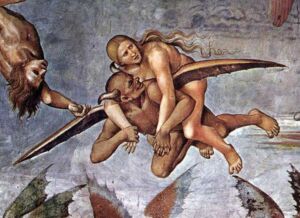 upward journey is a common spiritual theme in the life of the Church.
What’s the alternative? The downward slide. Or getting dragged downward by the wickedness of the world, the flesh, and the devil. I recall meeting a young man once who told me of a drug-induced experience he once had where he felt like he was sliding down into a very dark and cold pit. I went cold just listening to him describe it.
As he was trying to resist the slide, he said he distinctly felt something like a demonic hand grip his arm and begin to drag him downward. He yelled “No!” at that point and immediately came out of his comatose experience. He was one of the lucky ones who escaped the horrific grip once it bit into him.
That too reminds us that there is an opposite direction on the ladder, and we can all travel it or be dragged down to it. It’s the inverse Theology of Descent, and we all have to battle against it in this life to get to the next in one piece.
The Invitation to Go Higher
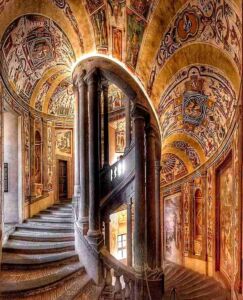 Maybe that’s why some of the great staircases of the world seem to entice us to walk up them. God invites us to Him, He doesn’t drag us up. We must choose it. And some of the most brilliant staircases in the world tell us that it can actually be a pleasant journey.
Look at this masterpiece in the Palazzo Farnese in Caprarola, Italy, for example. Just wow. I don’t know. It feels like an inviting place. Don’t you just want to keep climbing to see what’s at the top!
(Fun fact, there’s just a small landing at the top with a sign that says “Keep away from the balustrade”!)
Spiral Staircases
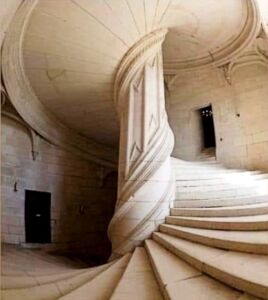 Apart from the analogy that life is often a spiraling and dizzying experience, there is a practical dimension to a staircase like this: the spiral design economizes best where space is limited.
The Farnese palace points out a common characteristic of staircases: they are often crafted like huge corkscrews, spiraling structures that have the potential to make you dizzy if you go up and down them too fast.
Here’s another real beauty allegedly created by Leonardo da Vinci for Chambord Castle in France towards the end of his life.
It is a magnificent work of art, sinuous in its lines and breathtakingly elegant in its simplicity.
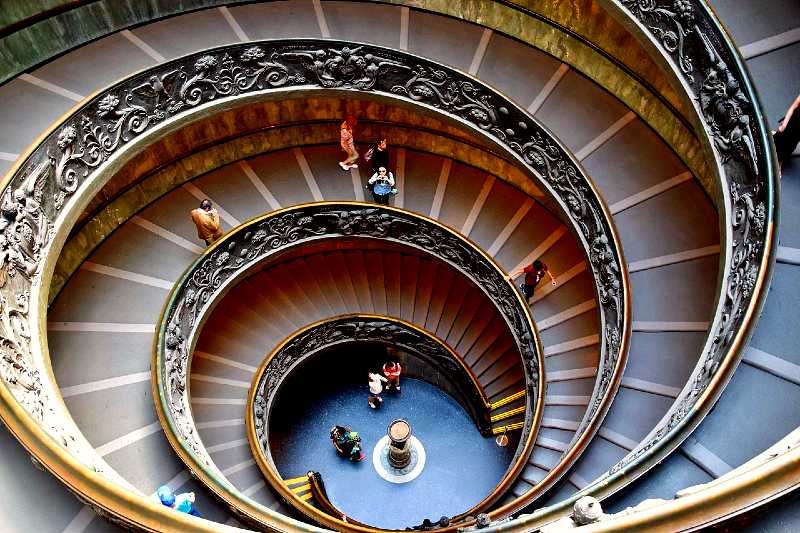
And probably the most famous spiral staircase in the world can be found in the Vatican Museums, called the Bramante Staircase after the Renaissance architect who designed the prototype for this structure (image below).
I’ve written a whole article on this one, but here’s a good view of it to give you an idea of its magnificence. [See, “The Mollusk That Visited the Vatican”]
Elegance in Stone
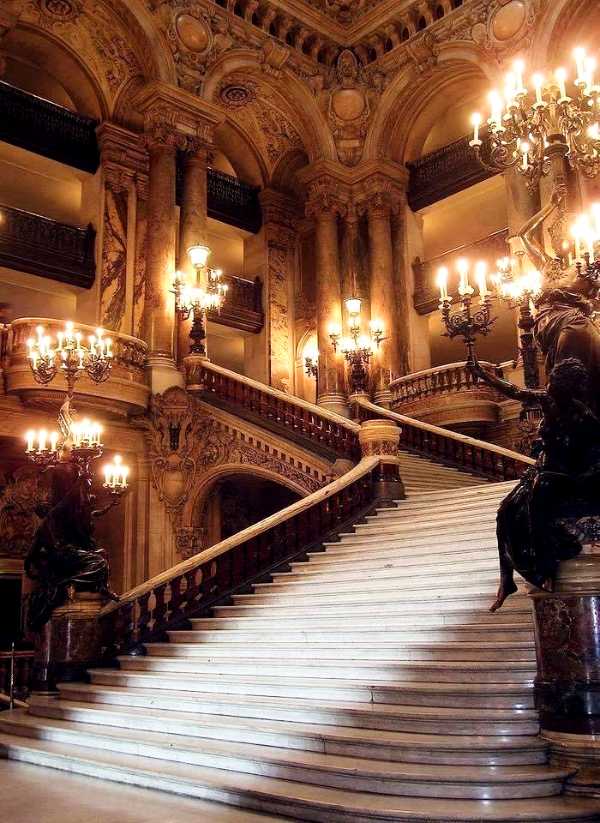
While space is a limiting factor in some buildings, it does not seem to be an issue with some of the most palatial staircases in the world, which are examples of sheer elegance in stone. Here you can see the staircases of the Royal Palace of Naples, Italy (left), the Paris Opera House (center), and the Wells Cathedral in Somerset, UK.
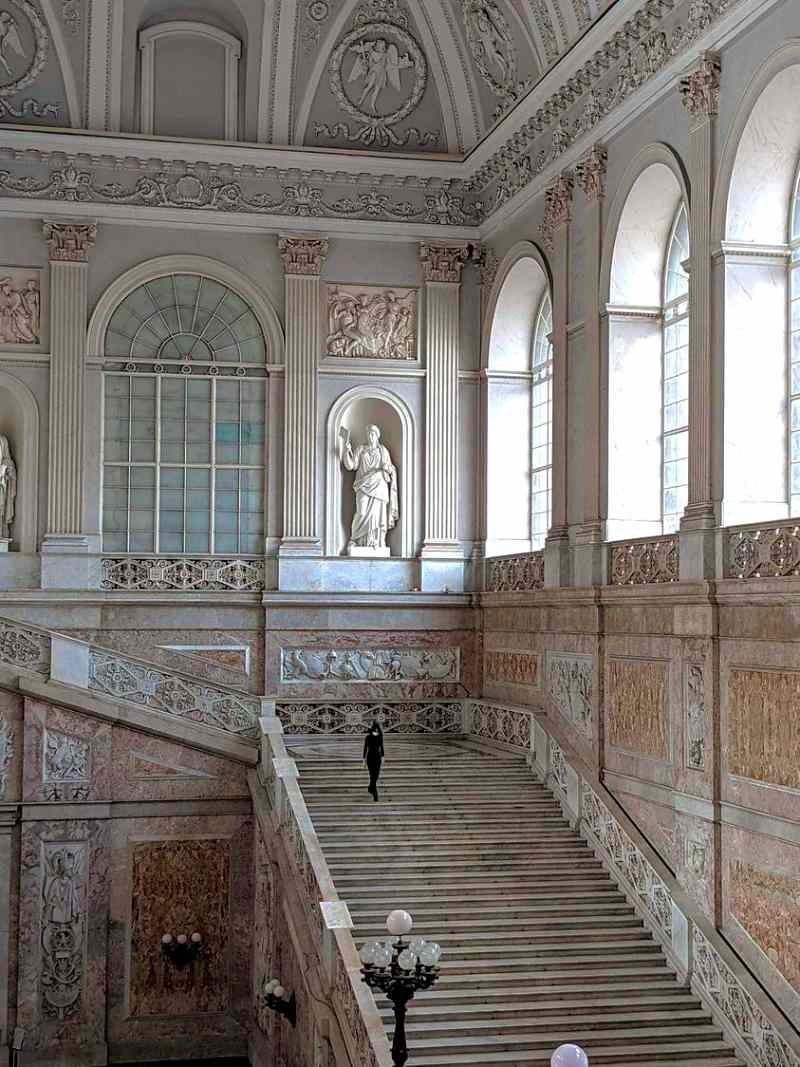
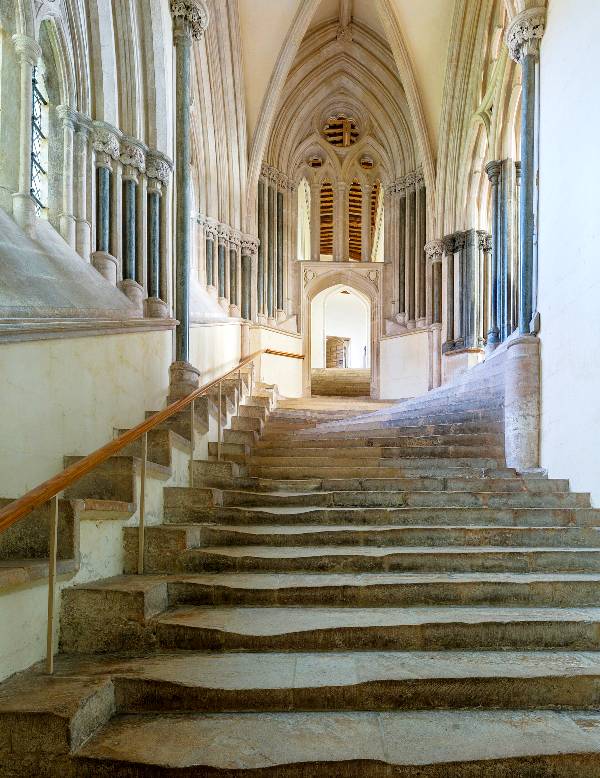
You can’t help but notice the worn stairs in the Cathedral, bespeaking eight or nine centuries of continual devotional use by clerics, pilgrims, and parishioners alike. A true stairway to heaven. Speaking of which…
Natural Stairways
Gate of Heaven
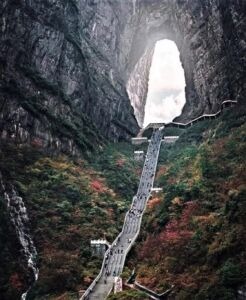 Nestled in the Tianmen mountains of Hunan Province in southeast China is a massive geological formation which has become known as the Gate of Heaven Arch. I don’t think the name needs any explanation at all!
The opening looks like a portal to another realm, something you’d see in a Star Wars movie. The opening is so huge (443 ft. high, 187 ft. wide), you could fit an entire football field vertically into the hole and still have enough space to fly a commercial airliner through the remaining gap.
From the base platform, there are exactly 999 stairs set at a 45-degree angle leading up to the gigantic opening. In Chinese culture the number 9 is considered lucky and was once considered the sacred number of the Chinese emperor, who was called the Son of Heaven.
(The road leading up the mountain has 99 switchbacks. I have no idea how they managed that.)
On foggy days, banks of clouds fill the massive arch making the long stairway look like a pathway into the great Beyond. Hence the name, Gate of Heaven. The point: even a pagan culture like the Chinese recognize heaven as an upward journey.
St. Helena Jacob’s Ladder
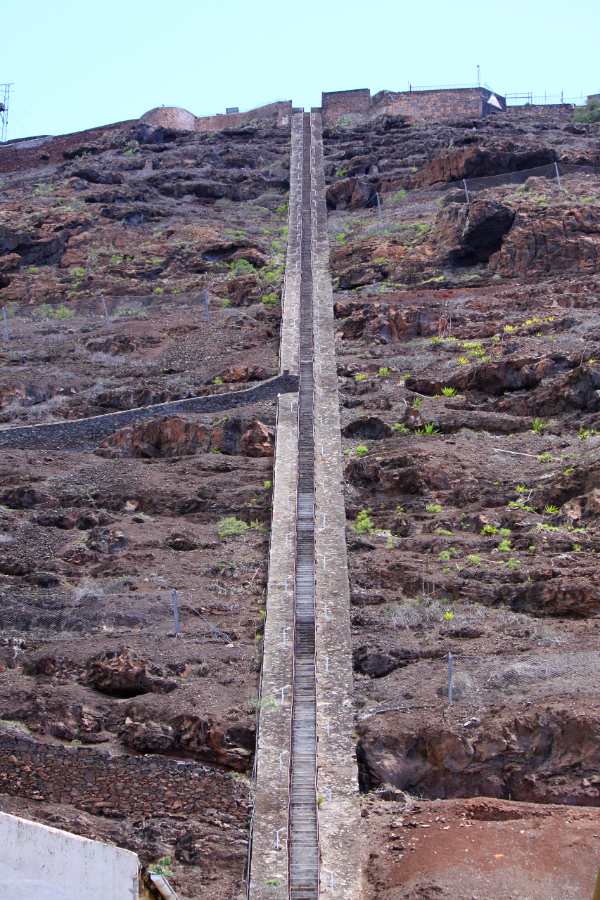
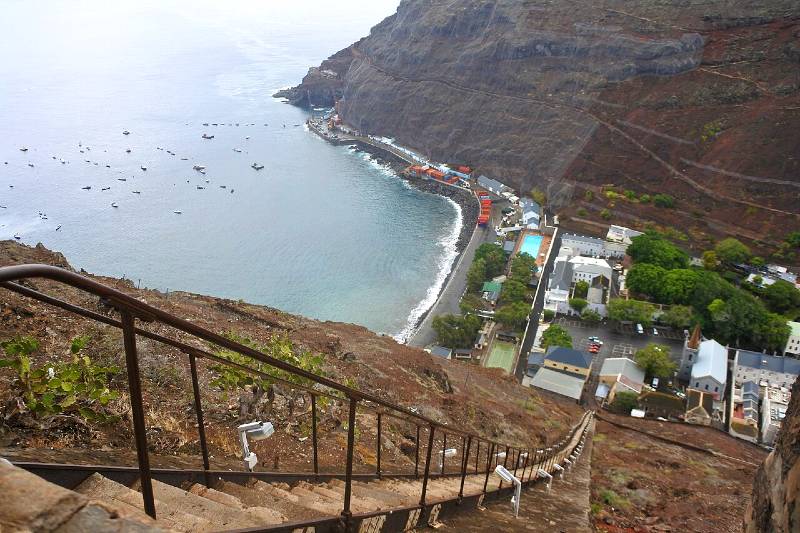
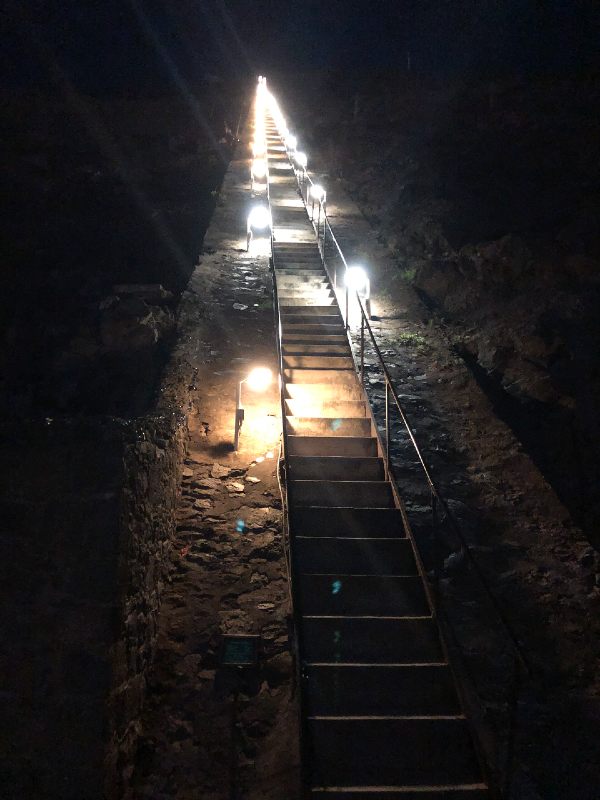
Another natural staircase (with a little help from man’s chisel) is the 699-step climb called Jacob’s Ladder on the island of St. Helena in the middle of the Atlantic Ocean. It was built in the 1820s as a railway to haul materials from the capital city of Jamestown up the mountain to the fort at the top.
You may recall that the Emperor Napoleon was banished to this remote island following his decisive defeat at the Battle of Waterloo in 1815. He was imprisoned there for six years until his death in 1821.
Each year, the island holds a foot race up the staircase. The winning time, set in 2016, remains at 5 minutes, 16.78 seconds. You don’t appreciate how steep the climb is until you look downward!
The Two Holiest Staircases
Dare I say that there is a “scale” of holiness in staircases? Two monumental gifts of God stand out for us in the realm of holy staircases, and I’m sure you’ll see why.
 The Scala Sancta in Rome
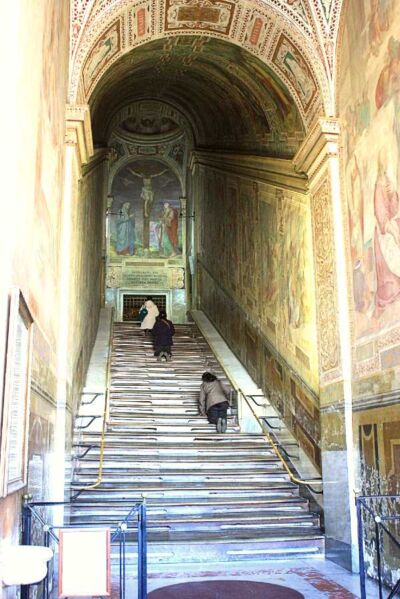
The Papal Basilica of Saint Lawrence outside the Walls contains one of the holiest pilgrim sites in the Catholic world. It is a set of 28 marble stairs reputed to be the staircase that Jesus walked up to speak to Pilate in the Roman Praetorium. It was brought to Rome by St. Helena in the 300s.
Walking up it, Jesus would have been covered in blood from the Scourging and adorned with the purple robe Herod had mockingly placed on him.
It must have been a dramatic scene. In Mel Gibson’s 2004 Passion movie Jesus is shown speaking to Pilate in Latin, which was the only time in the movie when anyone spoke in a language other than the native Aramaic. It was easy to miss the nuance because the subtitles of both languages were in English.
Pilgrims often walk on their knees in ascending the Scala Sancta as an act of penance and a sign of union with the humble Jesus. Notice the massive fresco of the Crucifixion at the top of the stairs.
The Loreto Chapel in Santa Fe, New Mexico
The legend surrounding this mysterious staircase has it that a man of middle eastern descent showed up at the convent of the Loreto Sisters one day and offered to build a stairway to their choir loft in the back of the nuns’ chapel.
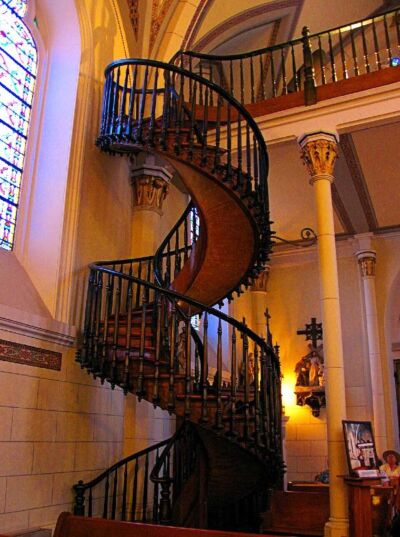 The sisters eventually concluded that the man was St. Joseph himself who had compassion on their need because the carpenters who built the choir loft hadn’t built any stairs to access it 20 feet above the floor!
I can imagine St. Joseph looking at that and shaking his head saying, “Do I always have to go down there and fix their carpentry messes?” Well, maybe it didn’t happen that way, but I think St. Joseph’s motto must have been “Always Upward!” And fix it he did.
The staircase has 33 steps and was made without a single nail. It was crafted from a type of acacia wood that had no known origin or supplier in the southwest United States where any normal carpenter would have gotten his wood.
But St. Joseph was no normal carpenter. And when he finished his work he left without a trace, accepting no payment. Oh, and would you be surprised that the nuns had, just prior to his arrival, prayed a novena to St. Joseph to fix their balcony problem?
Always Upward
Well, the good foster father of Jesus knows, as all saints do, that there are no elevators to take us to heaven. We have to climb. We need resources for the spiritual journey like Word and Sacrament to nourish our souls, friends and family striving for holiness, and above all, grace to keep our eyes looking upward.
I’m convinced that ladders and stairs have a lot to teach us about the upward journey. It doesn’t have to be all drudgery. But really, who thought staircases could be so beautiful?
———————
Photo Credits: Feature image: Panna Meena Ka Kund (sha); Bath Abbey (Bärbel Miemietz); Loreto Chapel (karol m from Arizona); Scala Sancta (Dguendel); Palazzo Farnese (Facebook, source lost); Chambord Château and Gate of Heaven (Facebook); Wells Cathedral (Diliff); St Helena Jacob’s Ladder (Kevstan); Downward view (Luke McKernan); Devil with woman (Luca Signorelli).
———-
[Note: This article is a reproduction of the Sacred Windows Email Newsletter of 3/8/26. Please visit our Newsletter Archives.]




.jpg)

Leave A Comment