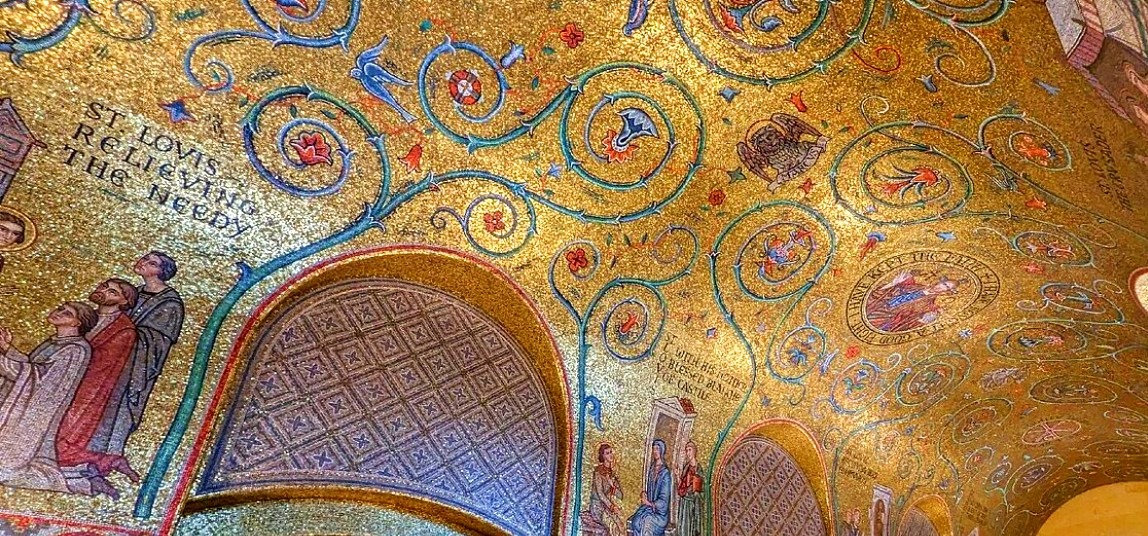
If you are not fascinated by the beauty of church mosaics, maybe I can help. I spent a few days in St. Louis, Missouri over the holidays and visited the church that reputedly has the most extensive collection of mosaics in the entire world: the Cathedral of St. Louis.
The only problem with this temple to mosaics is that the images are about 100 feet above your head—it’s hard to take in their full brilliance! Thankfully, I thought ahead and brought my binoculars. Read more about it in a previous SW article:
But the St. Louis Cathedral is a newcomer to the world of mosaic art. The pedigree of mosaic-decorated churches stretches back to the early days of Christianity and many of the cathedral’s predecessors are stunning testaments to this glorious artform.
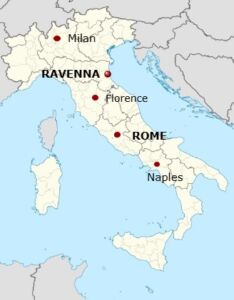 Of special interest is the city of Ravenna in northern Italy, which has one of the greatest concentrations of mosaic art in the world, both religious and secular. Sicily is another center of mosaic wonder, but most of those are from a later period. Ravenna is essentially the queen and epicenter of mosaic art in the West. I’ll give the details below.
A World of Shimmering Stones
First a word about mosaics. The art form predates the Christian church by centuries. It was commonly used in the days of the Roman Empire as decorative flooring. The number of mosaic floors in ancient Pompeii, for example, is quite impressive.
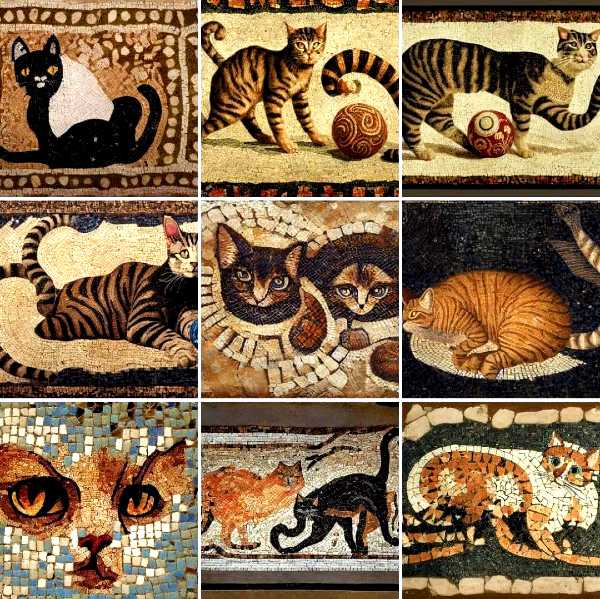
Incidentally, archeologists recently unearthed a villa with at least two dozen cat mosaics, which gave rise to a local legend about Pompeii’s destruction. As the story goes, one of the villa’s cats, named Vesuvia, escaped and went to the top of the volcano. There, she pushed a rock off the edge of the cone, and when it fell into the lava below, it triggered the massive eruption. No serious historian endorses the theory, of course, but all cat owners believe it to be true.
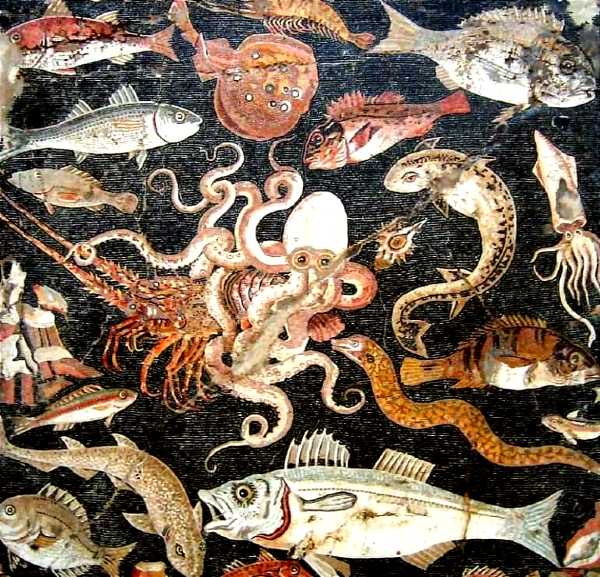
Anyway, here are some of the cat mosaics and an extraordinary mosaic floor from Pompeii which features amazing images of aquatic life (an octopus fighting a lobster!)
The Romans gave the name to this art form, musaicum, which is a derivative of the Latin term for “museum”, meaning a collection of books or diverse works of art. In the same sense, a mosaic is a collection of myriad-colored stones or pieces of glass that form a coherent image.
The genius of the Christian use of mosaics in churches is that they not only shimmer but are fixed to arches, domes, and ceilings without the pieces falling onto the heads of worshippers below!
A Quick Note on Perspective
When mosaics are placed on a dome or church ceiling, the trick is to get the image to be visible from the ground without losing its proper proportions. It’s a complex thing, but it’s also kind of a numbers game.
If a dome rises several hundred feet in the air (such as St. Peter’s Basilica in Rome—internally 386 ft.), the images have to be proportionately huge to be able to see the details clearly from the ground.
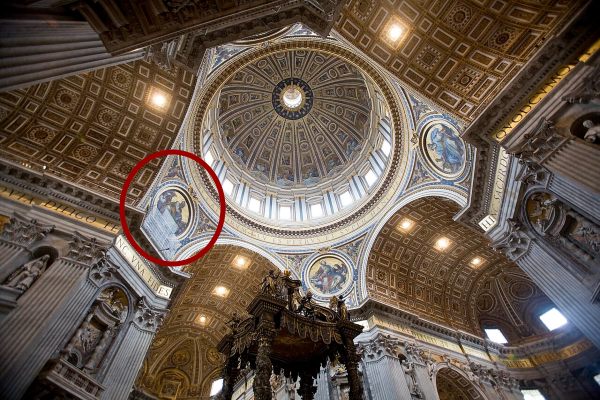
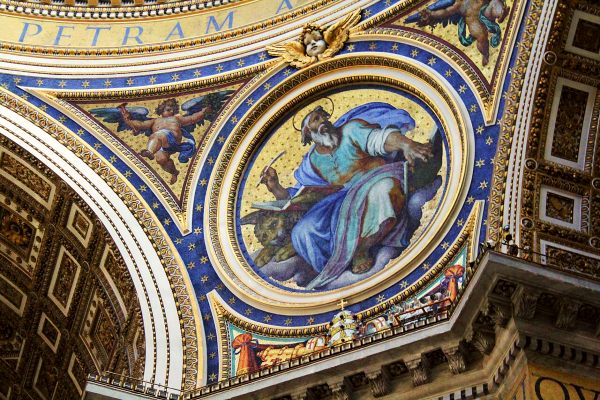
In St. Peter’s, the tops of the four pillars holding up the massive dome are decorated with round mosaics of the four evangelists. The one that features St. Mark shows him holding a quill pen that he uses to write his Gospel (precariously perched on the head of a lion, his symbol).
Now, a quill pen in your or my hand measures less than 12 inches. The quill pen of St. Mark on St. Peter’s dome measures six feet in length! It’s all a matter of perspective.
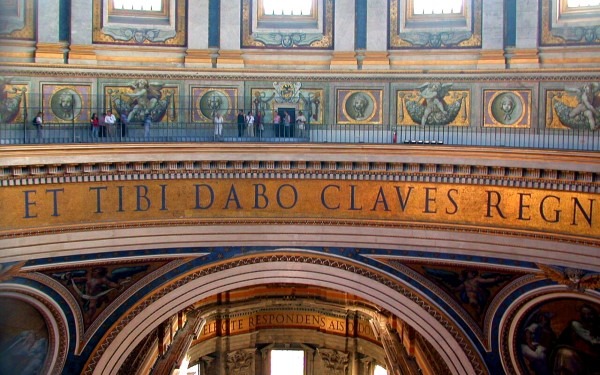
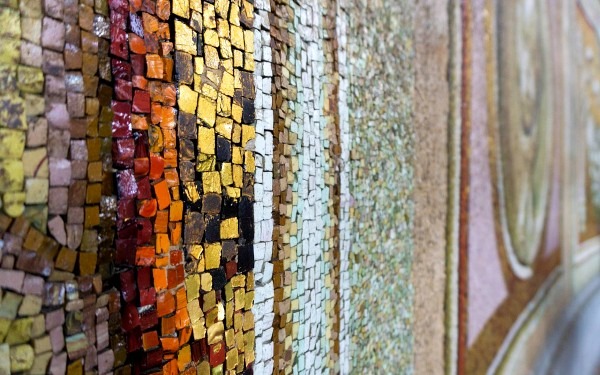
Here you can see the letters in the inscription running around the base of the dome. They are about the same height as St. Mark’s pen; and notice the size of the people standing on the walkway just below the windows. Above their heads rises the great dome, and every inch of it is covered with mosaics. The further up you go on the dome, the larger the mosaic pieces get. The pieces pictured here are a couple inches wide.
The Uniqueness of Ravenna
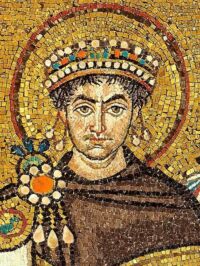 Now on to the subject at hand: Ravenna. It was for a time the capital city of the late Roman Empire when the city of Rome itself had become so weakened by war and internal decay that it was no longer able to function as an administrative center of a great empire.
By that time, the Roman empire had already been divided. It was a double-headed dragon with two Roman emperors, one with a capital in the East (Constantinople, modern day Istanbul, Turkey), and the other in Rome, the capital in the West. Ravenna stood on the border of East and West, so its history was bound up with both of them, but mostly with the East, as we will see.
The Roman Emperor Honorius moved the capital of the Western Roman Empire to Ravenna in 402 AD to avoid barbarian raids, but its glory as the “second Rome” lasted less than a century. A thumbnail history of the period goes like this:
- The Visigoths besieged Rome in 410 AD. The Romans gave their leader Alaric two-and-a-half tons of gold and 15 tons of silver to go away, but after he received it, Alaric changed his mind and sacked the city anyway, taking every piece of movable property. Of course he did. Barbarians are the same in every age, ours included.
- Attila the Hun intended to attack Rome, but Pope Leo the Great somehow convinced him to withdraw in 452 (probably with another huge payoff) and this time it worked! The Vandals, however, sacked Rome a few years later (455).
- When the Visigoths arrived at the door of Ravenna in 476, the Roman Emperor was a teenager named Romulus Augustus whom the Visigoth king, Oadecer, deposed from his throne after only ten months in power.
The glorious Roman Empire of the West thus ended, “not with a bang but with a whimper,” as the poet T.S. Eliot said. The Visigoths ruled Ravenna until 455 when the Eastern Emperor Justinian sent his forces to take it back.
The mosaic history of Ravenna flows out of those diverse influences on Ravenna’s culture, both Visigoth and Byzantine, for the next several hundred years. If you visit Ravenna today you will find it hard to choose from all the places where you can see magnificent mosaics, but I will focus on three of the most impressive places.
The Basilica of Sant’Apollinare
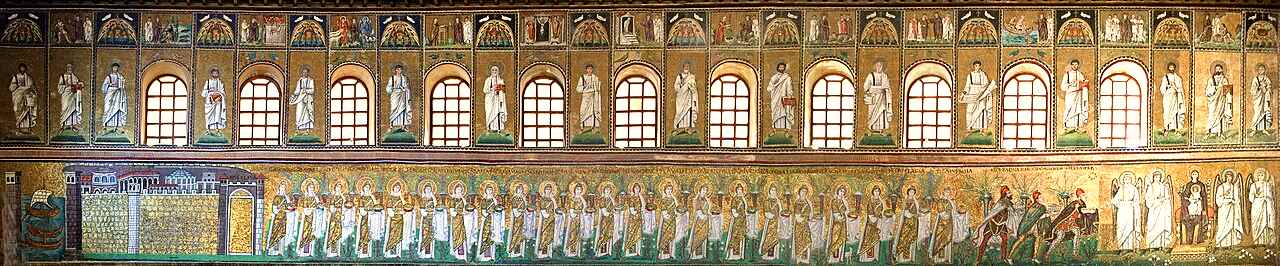
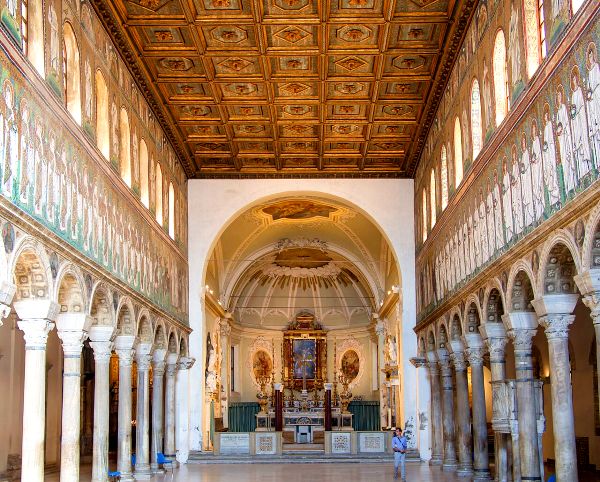
This church was built by the Gothic King Theodoric in 504 and named after the patron saint of the city, a bishop and Roman martyr named Apollinaris. It has the classic “basilica” style which consists of one long nave flanked by columns on both sides and high walls (perfect for artwork).
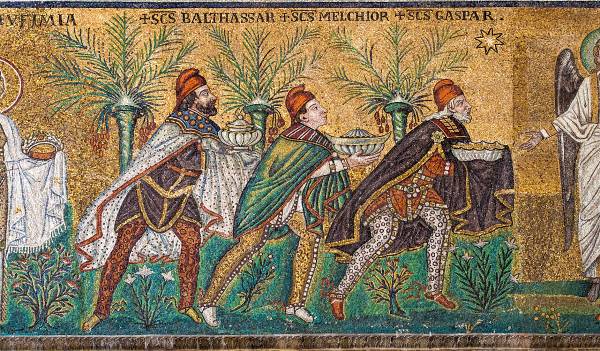
Basilicas were usually crowned by a half-dome over the sanctuary. What I find most stunning are the mosaics that run all the way up the aisle on either side. The walls are entirely filled with mosaics. Notice the image of the three kings on the lower right leading the procession.
The Church of San Vitale
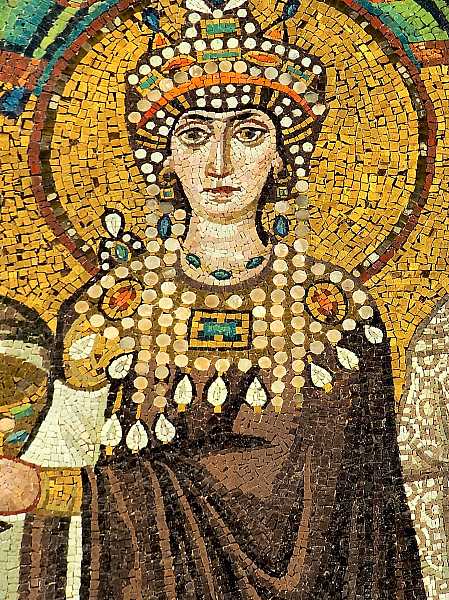
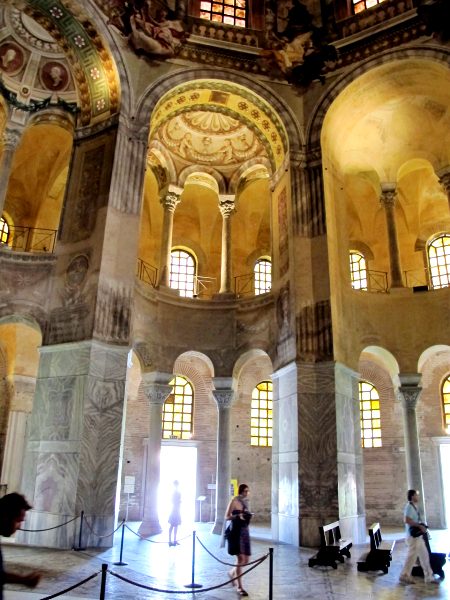
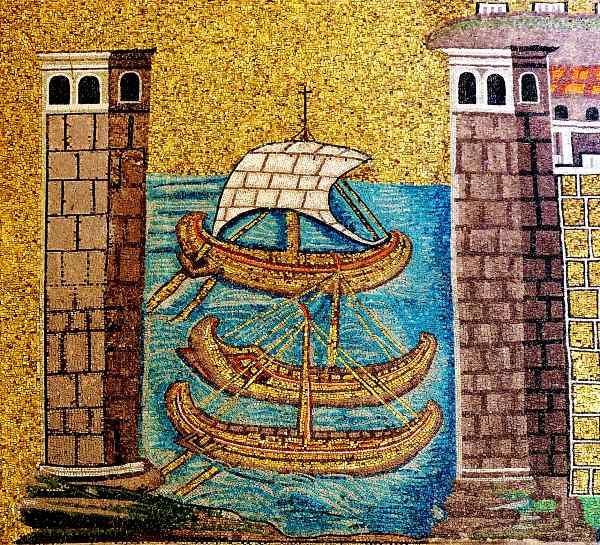
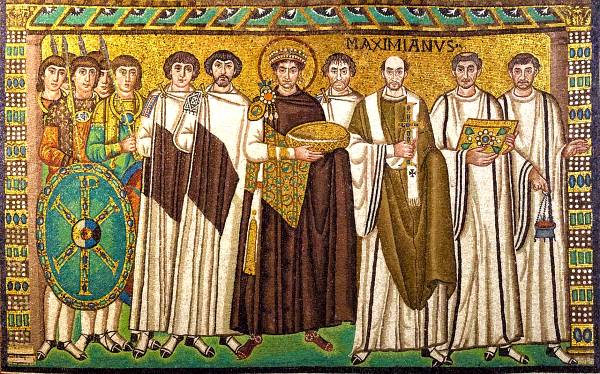
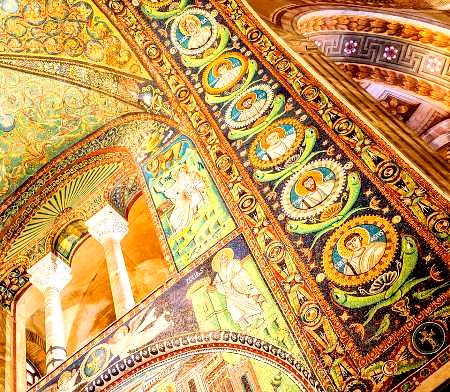
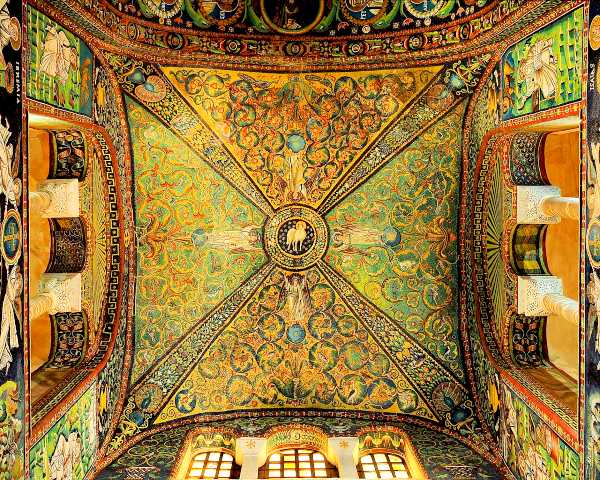
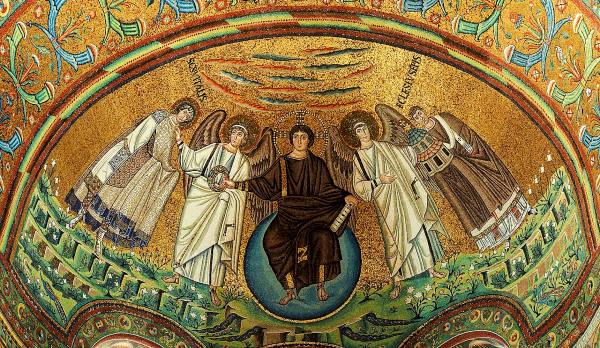
The mosaics in this church are even more impressive than Sant’Apollinare if you can believe it. This church was begun by the Gothic rulers and finished by the Byzantines under Emperor Justinian in 547, who made sure to have his and his wife’s images emblazoned in stone. In the mosaic of Justinian, you’ll notice that there is also a bishop to his left who pushed his way into the imperial selfie. Some things never change.
San Vitale is the only church of its period to survive virtually intact from its original creators—1600 years ago. Wow. It’s a real beauty, and the mosaics speak for themselves.
The Mausoleum of Galla Placidia
Our third feature is not a church. It is a mausoleum for the daughter of the Emperor Honorius, named Galla Placidia. She was a remarkable woman who was married to the Gothic king in a political alliance just after the fall of Rome. When her husband died, she ruled the empire while her son was still a minor.
This building was originally meant to be the entranceway to a church that no longer exists. I’m not sure that walking through a dark tomb is the best way to dispose yourself for Mass, but the Empress didn’t ask my opinion on that matter. Then again, despite being called a mausoleum, it doesn’t actually hold her tomb either. She is believed to have died in Rome.
Here we have mosaics that shine beautifully when the light reaches them. If you were able to get up close to them, you would see that the stones of the mosaics do not form a smooth surface. They are made of irregular shapes some of them even with jagged edges sticking out, deliberately, to more effectively reflect the flickering internal light of lanterns and make the mosaics shimmer. Super lovely!
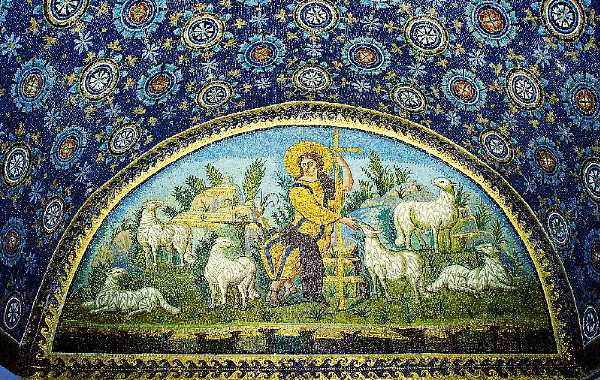
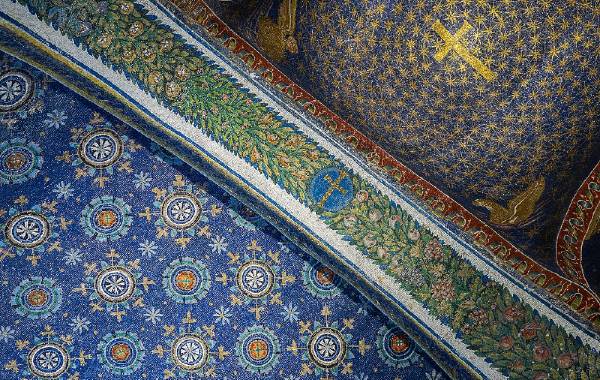
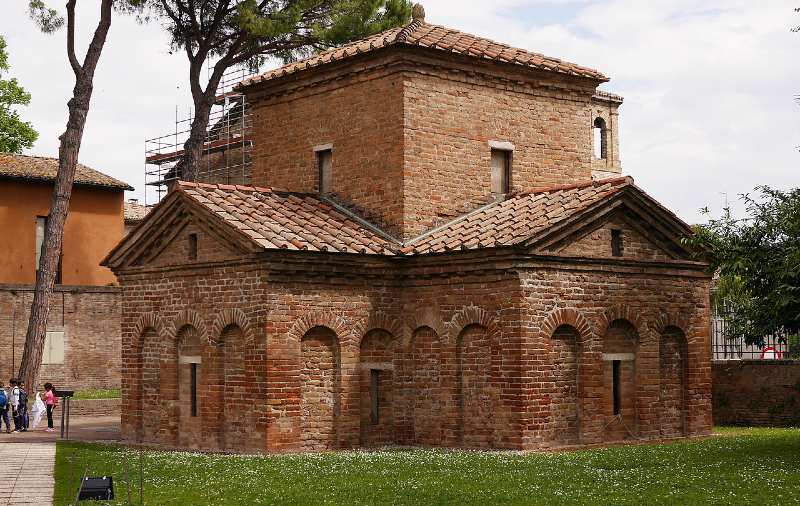
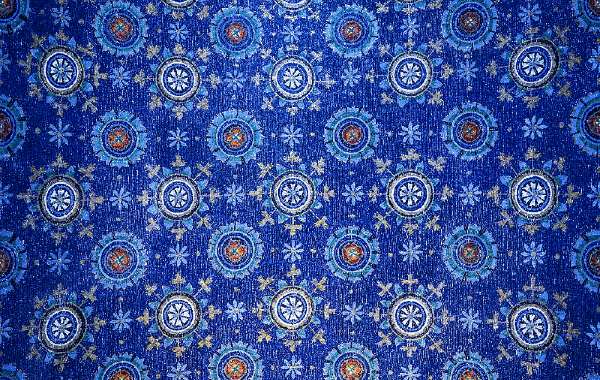
In all, Ravenna has the most potent collection of mosaics in the West. There you can see churches, palaces, baptistries, tombs, other buildings, public and private, endowed with sparkling artworks of colored glass. The whole city, in a sense, stands as a monument to a magnificent culture that produced so much beauty to enlarge the human soul.
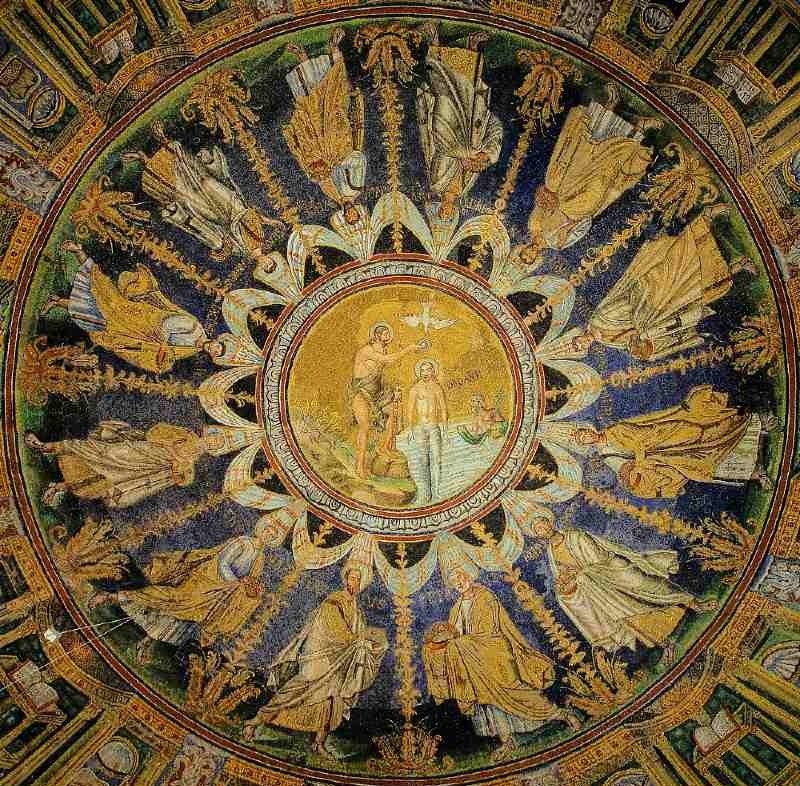
And just to spice it up a bit, here is the amazing domed ceiling of the Neonian Baptistry in Ravenna—just too beautiful to skip!
A final word about why we might consider mosaics as sacred windows. This is my own theology, but maybe it will resonate with you.
The Mosaic’s Symbolism
The enchanting beauty of a religious mosaic is found not only in its colors and dynamic imagery but also in its symbolism. Human beings are often fractured, flawed, interiorly-divided, and full of contradictions—like those many pieces of colored stone that make up a mosaic. We’re also colorful, we have to admit.
All those pieces are not always held together securely, though, as witnessed by the destruction of so many works of art and churches through the ravages of time. Likewise, sometimes people’s lives literally “fall apart” as if the picture lost its inner unity and the collection of stones disintegrated into a pile of rubble.
Our lives can be like mosaics in that way: fractured and fragile. The challenge is to let the Divine Artist build us, or at least, when everything crumbles, to let Him re-form the picture anew, piece-by-piece, until we become the beautiful work of art that God meant us all to be.
———-
Photo Credits: Feature image (St. Louis Cathedral): Pixabay; St. Peters (Dome; St. Mark; Inscription-People; Mosaic); Pompeii Cats (Elisabetta Volpi); Pompeii Fish (Chappsnet); Sant’Apollinare (Nave/Apse, 3 Kings, Basilica/Dome, Panorama); San Vitale (Vault; Triumphal Arch; Half Dome; Emperor Justinian; Interior); Mausoleum-Galla Placidia (Exterior; Stars; Arch; Good Shepherd); Neonian Baptistry (Petar Milošević); Emperor Justinian (Petar Milošević).
[Note: This article is a reproduction of the Sacred Windows Email Newsletter of 1/25/26. Please visit our Newsletter Archives.]




.jpg)


.jpg)

.jpg)
.jpg)
Leave A Comment