

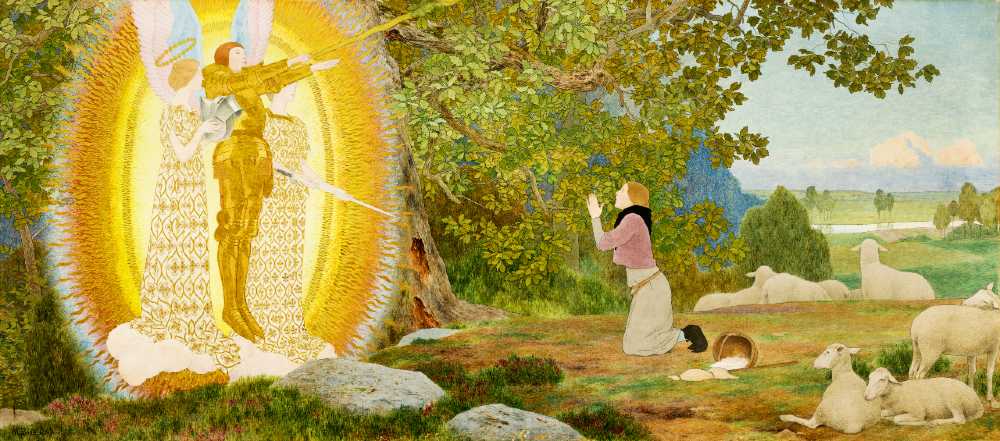
In 2031, our Church will commemorate the 600th anniversary of the death of the indomitable patron saint of France, Joan of Arc. We are still five years away from that great event, but I’m already getting excited!
But before I get ahead of myself, I’d like to present a few fascinating facts about Joan of Arc in honor of her feast day (May 30) that might get overlooked in the broad strokes of the stories we generally hear about her. But these are just a few tips of the iceberg of an endlessly wonderful and interesting life.
In the limited space of a newsletter, I can only offer four tiny stories, but I’ll soon be publishing another book about her life to expand on the material here. I’ll keep you posted on that. In the meantime, let’s learn a little about one of history’s most beloved warriors.
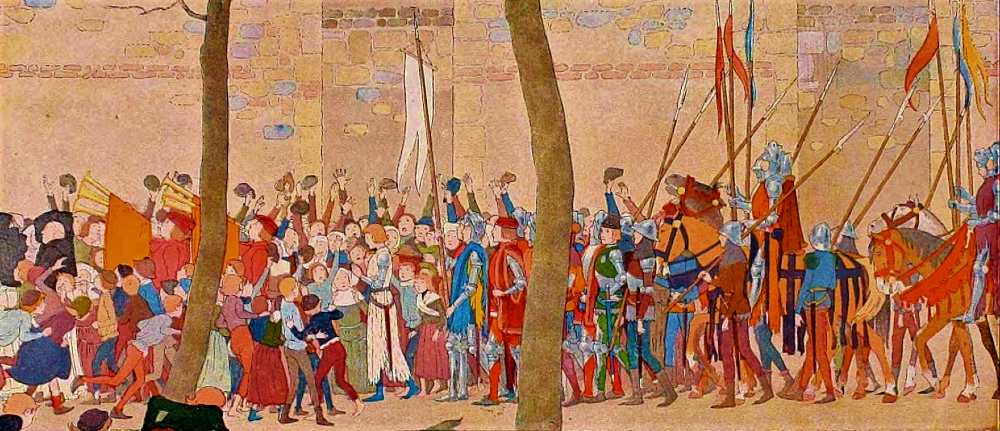
Joan entering the City of Orleans, May 1429
She was never called Joan of Arc
If you grew up with Joan of Arc in the little village of Domrémy (in the northeastern corner of France) you called her Jehanne or, more probably, you used the diminutive form of her name, Jeannette. Jehanne is a medieval version of the French female name Jeanne, clearly based on the Latin name Johannes for John.
In English we would call her Jean or Joan or Jane or Janet or Jeanette. It’s complicated.
As for her last name, Arc, no, she didn’t ride on Noah’s Ark if that’s what you’re thinking. Arc was her father’s surname, Jacques Darc (or D’Arc), probably based on the place his family came from. In fact, even that’s uncertain.
What is absolutely clear, though, is that neither Joan nor anyone else referred to her by the surname of Arc because that’s not how the French did it in medieval times. They would have called her Jehanne from Domrémy or Jehanne Vouthun (her mother’s surname), but not Jehanne Darc or Jeannette D’Arc or Joan of Arc.
Actually, once she went public, everyone just called her “The Maid” (in French, “La Pucelle”), which was a common term for an unmarried woman.
But Joan was not just a random maiden in France. She was the Maid of France.
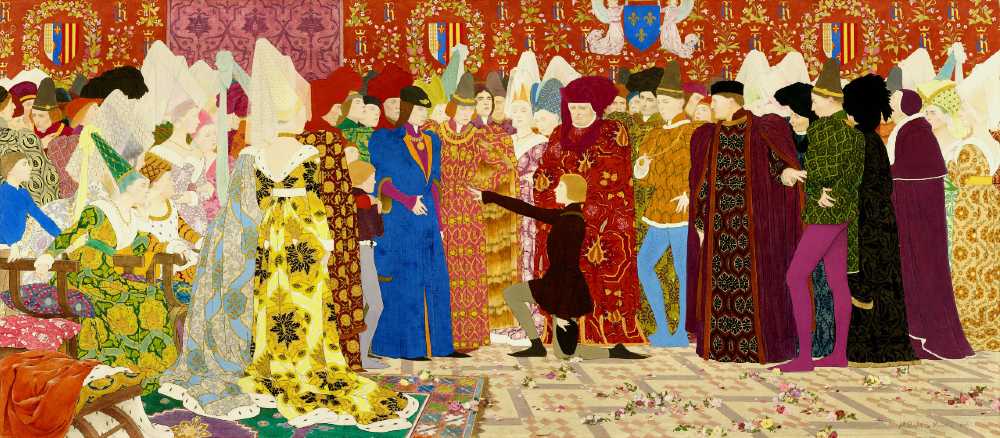
Joan at the Court of France, February 1429
Her own father threatened to drown her
Now, lest you get the wrong impression of Joan’s dad, there’s a backstory to this title. When he heard rumors that his teenage daughter was thinking of running off to war, he was, shall we say, alarmed—as any good father would be—especially given the brutal conditions of war in the Middle Ages.
Also, Joan apparently didn’t communicate her plans for saving France to dear old dad, and that, of course, made things worse. (What? A teenage girl hiding things from her parents? I’m shocked.)
Yet, her father’s sense of impending doom was more than a rumor. It was personal. As Joan was seeing visions of angels and saints, Jacques himself was having a few 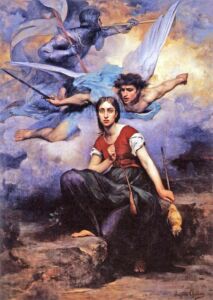 vivid dreams about his daughter putting on military garb and running off with soldiers. And Jacque’s dreams were, in fact, totally correct. Joan was planning on running off to war.
The problem, however, was that Jacques didn’t have all the information and interpreted his dreams in the most negative light. He thought his daughter was going to be some kind of camp follower, one of those women of “ill repute” who normally hung around armies. That did nothing to brighten his already dismal mood.
To put the best interpretation on it, the father was so concerned about his daughter that he told her two older brothers that if Joan ever tried a stunt like that, they should take her down to the Meuse River near their house and drown her. He added that if they refused to do it, he would do it himself.
Harsh, I know. Was that the way medieval dads showed concern? When she heard about it, the news must have frightened Joan to the core, yet, she was resolute.
She would later tell her interrogators at trial that even if she had a hundred mothers and fathers and even if she were the daughter of a king, she still would have left for her mission, as God had commanded her.
That’s pretty much the steel will of a saint. Dad was tough, but daughter was tougher.
Later on, after her great victories over the English, it is believed that her father apologized to her for such a rash statement—maybe. I’m inclined to give Jacques credit for being a protective dad. He also acknowledged the larger picture of his daughter’s extraordinary vocation when it finally became clear to him.
No historical record indicates what Joan’s brothers thought about the drowning plan, but those two eventually went off to war with her. We can see where Joan got her warlike character. It was a family trait.
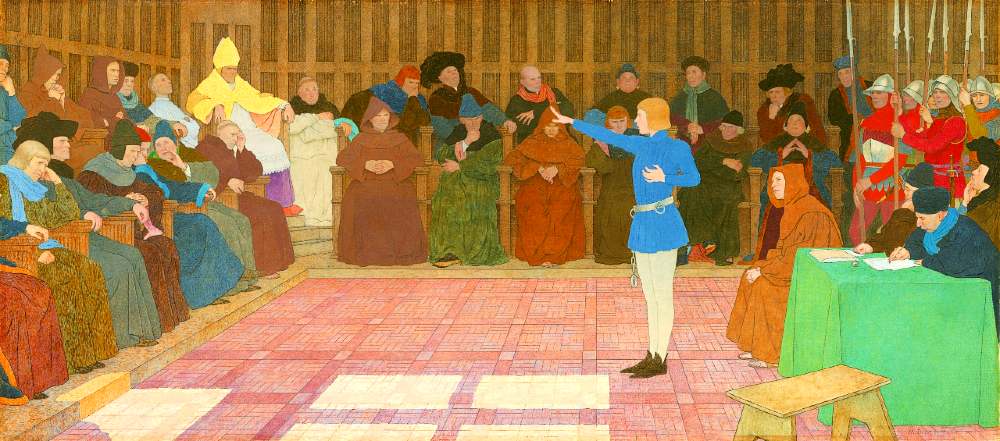
Joan before her interrogators, March 1431
Joan knew what language St. Michael the Archangel spoke
The excruciatingly long and awful trial of Joan of Arc is the subject of many books, but for our purposes, we can only look at one line of inquiry at the trial that condemned her. Her interrogators wanted to know all about her conversations with St. Michael the Archangel.
You know, I can’t say I blame them. If someone came to me claiming to have spoken directly to the most powerful angel of heaven, I’d want to know a little about that meeting too. Both her friends and her enemies interrogated her on this subject, but her enemies were not so nice about it.
They wanted to prove that her conversations with an angel were the ravings of a religious fanatic, or communications with the devil, or even a sort of heretical mysticism. They sought to discredit all her astounding victories and damage the reputation of her patron, the king of France (you’d think they were the American media or something). You can hear the interrogation now:
Oh sure. Uh-huh. Right. You’re having visions of the great archangel, haha! Let me guess: You’re the only one the great St. Michael spoke to, and he told you that you would be the savior of France, right? Is he speaking to you at this moment? Is he here in the room with us now? The men in the white coats will be here shortly.
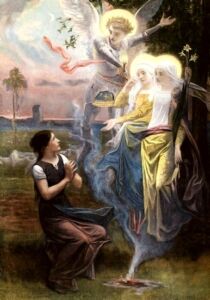 That bit is from my imagination, but in fact, some of the documented questions were just as silly: they wanted to know what kind of clothes the angel wore, what color his hair was, etc. Clerics versed in theology should have known better than to ask these material questions about a spiritual being. Then they asked her the fatal question:
They wanted to know if St. Michael spoke to her in … [gasp] … English.
Big mistake.
Joan shot back: “Do you think an angel would speak the language of God’s enemies?!” (That’s my rough translation from the Medieval French, but clearly Joan was annoyed at the question.)
No, St. Michael didn’t speak to Joan in English or even in her native dialect of French. In fact, Joan never disclosed what language the glorious angel actually spoke because, as asked, it was an unanswerable question.
Angels don’t speak the way humans do. They usually don’t use words at all when they interact with our kind. They simply communicate directly to the mind without need for those pesky things called words that humans use to communicate. So, in their encounters, Joan understood with crystal clarity everything the Prince of the Angelic Host said to her.
Kind of like what happened when the Holy Spirit came upon the Apostles on the Day of Pentecost (Acts 2).
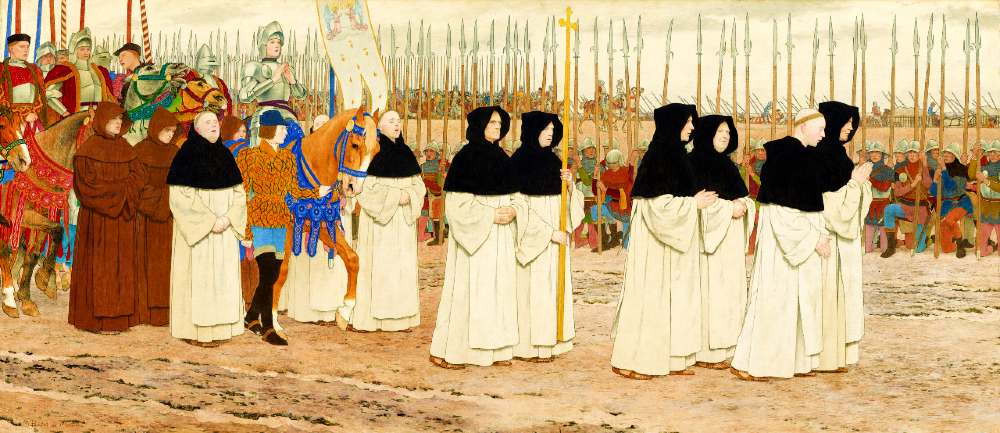
Joan leading her troops into battle, June 1429
Joan underwent an exorcism to prove she wasn’t a witch
In the Middle Ages, standing before a panel of theologians and insisting that you were not a witch only got you so far. You had to prove it. Now, it may seem unfair to the modern mind that someone accused of witchcraft was forced to prove a negative, but that’s how they ran back then.
When it comes to the most negative thing of all—the devil—there was an easy way to prove you didn’t belong to him: just have some priest perform an exorcism over you. No problem! If you don’t start levitating, vomiting pea green soup across the room, twisting your head around 180-degrees, you’re probably good to go.
At that point in the Middle Ages, reasonable men could be swayed by lesser proofs of innocence like getting through an exorcism without a reaction. It wasn’t until later that those clever clerics invented the Catch-22 scenario of tying accused witches onto big levers and dunking them into lakes for prolonged periods of time to see what happened. If the suspects survived the plunge, they obviously did so by some power of witchcraft. If they didn’t make it out of the water alive…oh well.
Thankfully, Joan of Arc was spared all that. She just had to be patient at one point while a priest said some Latin prayers from the ritual book over her, and when she didn’t react like the girl in The Exorcist, they were fairly confident she was not a witch.
That assessment only applied to her friends, though. Her English enemies were never convinced that some backwater country girl could actually destroy them militarily without the help of the devil. Back then, the “all women must be believed” movement hadn’t caught on yet, especially among the English.
This was an important moment in Joan’s mission, and we must not underestimate it. She not only had to convince Church and state alike that she was from God, but first she had to prove that she wasn’t from the devil.
Anyone who staked a claim to be the savior of France had to be rock solid holy, or at least beyond suspicion of a sinful lifestyle that would be brought to light by the Church’s various litmus tests. And the first litmus test had to be spiritual: witch or no witch?
It was the local authority in Joan’s native region, a man named Robert de Baudricourt, who called in the priest to perform the exorcism on the unexpected savior of their country. Before he sent her off to the King of France, he had to be sure he wasn’t sending a spiritually sick person, a fraud, or a lunatic to the royal court. His own reputation was on the line.
Baudricourt was a careful man. And it’s always good to be careful when you’re dealing with devils, sorcerers, politicians, and saviors. And in case you were wondering. Joan passed the exorcism test with flying colors. Of course.
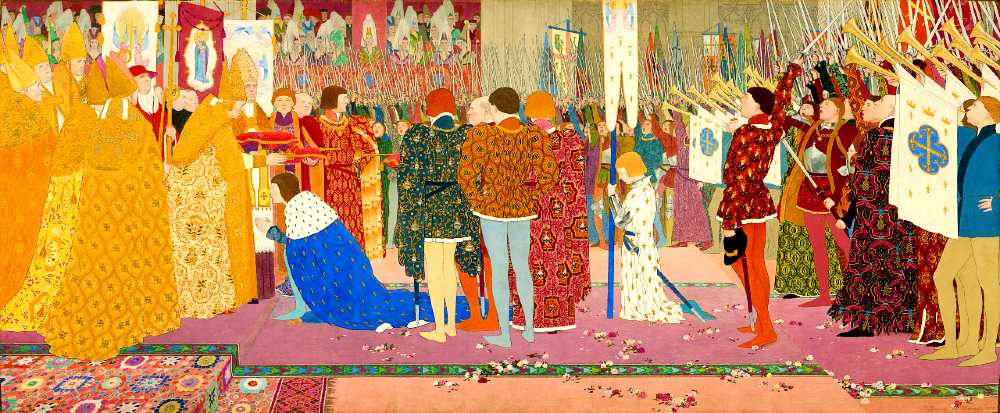
Joan at the coronation of Charles VII in Reims Cathedral, July 1429
A Prayer for Faith
There was and ever will be only one Joan of Arc. Let us conclude this brief look into her life with a prayer for faith. (Adapted from the website, Daily Prayers.)
Dearest St. Joan of Arc,
In the face of your enemies, in the face of harassment, ridicule, and doubt, you held firm in your faith. Even in your abandonment, alone and without friends, you held firm in your faith. Even as you faced your own mortality, you held firm in your faith.
I pray that I may be as bold in my beliefs as you, St. Joan. I ask that you ride alongside me in my own battles. Help me to be mindful that what is worthwhile can be won when I persist. Help me to hold firm in my faith. Help me to believe in my ability to act well and wisely. All for the greater glory of God. Amen.
—–
Photo Credits: Photos of artwork by Peter Darcy, 2020. Artist: Louis Maurice Boutet de Monvel (1851-1913), Joan of Arc Series, 1909-1910, Washington National Gallery, Washington SC. Public Domain images of Joan’s mystical visions: Eugène Thirion (1876); Diogène Maillart (1840 –1926).
[Note: This article is a reproduction of the Sacred Windows Email Newsletter of 5/31/26. Please visit our Newsletter Archives.]
Leave A Comment