


“From thence He shall come to judge the living and the dead.”
(The Apostles’ Creed)
The government-funded pleasure cruise that I took in the 1980s, more commonly called Marine Corps boot camp, taught me a lot about power. My drill instructor—one Staff Sergeant Hall—was a tough, colorful character who had a lot to say about power and its uses during the whole ordeal.
I think he had a Superman complex. He told those of us in the platoon who wore glasses that if we ever broke our glasses during the training, we would receive our very own stylish pair of government-issued, black horn-rimmed glasses to replace our lenses. Then he added: “And all y’all gonna look like Clark Kent.”
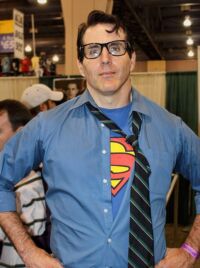 (For those of you who don’t speak Southern, “All y’all” is the plural of “y’all.”)
Not sure where that came from, but it must have been the Marine Corps’ version of a joke. As I said, Sgt. Hall was colorful.
His minor obsession with the Clark Kent/Superman image took an interesting twist when he lectured us about a particular duty on our first weekend liberty from camp. Surprisingly, he instructed us to go to church on Sunday while we were away:
“I’m a believer,” he said solemnly. “I believe in The Almighty, yes I do,” he declared in a rather unusual personal witness for that harsh environment. He was a man who understood how authority worked and his relationship with God reflected that.
And though he didn’t use the Name of Jesus, I interpreted his words to be an awkward yet sincere declaration of faith in Jesus Christ. It was easy for me to understand it that way. My Church had already taught me that Jesus Christ is the King of Kings and Lord of Lords—The Almighty.
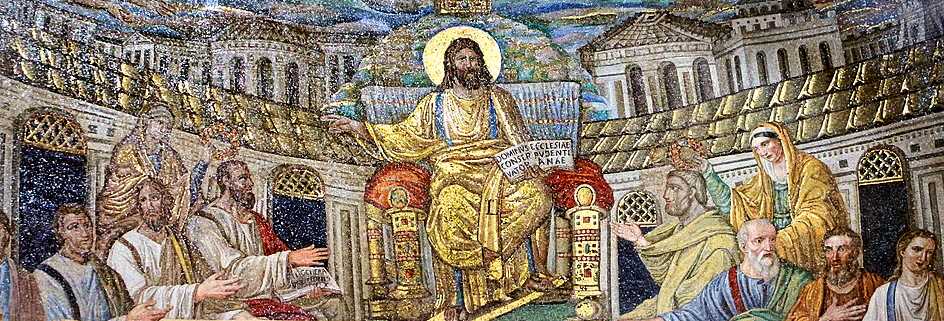
The Pantocrator
The Book of Revelation calls Him by the Greek term “Pantocrator,” which is literally translated, “holding all things,” that is, “the all-powerful one.” St. John the Evangelist must have been a closet Marine because he uses the term nine times throughout the entire book (1:8; 4:8; 11:17; 15:3; 16:7.14; 19:6.15 and 21:22).
Scripture testifies to the same in various ways but most importantly by Jesus Himself at His Ascension: “All power in heaven and on earth has been given to me….” (Mt 28:18). Not some power but all power. That’s a pretty stunning admission. Not even Superman can make that claim.
St. Paul also witnessed: “…at the name of Jesus every knee [will] bend, of those in heaven and on earth and under the earth, and every tongue confess that Jesus Christ is Lord, to the glory of God the Father” (Phil 2:10-11).
 The early Church took up this idea and expressed it as a doctrine: the Fathers of the Council of Nicea in 325 AD taught (and we still profess in the Creed to this day) that Jesus is the One who “…is seated at the right hand of God the Father…and will come again in glory to judge the living and the dead.”
An American Pantocrator
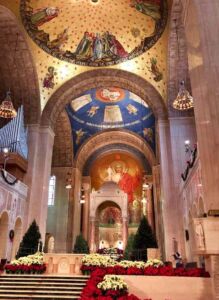
As it happened, in that first weekend liberty from bootcamp, I visited the National Shrine of the Immaculate Conception in Washington DC for the first time and saw the magnificent image of the Pantocrator in the apse dome at the very back of the basilica.
When I spotted it from a distance, it drew me like a magnet. I immediately made my way into the back area under the dome and craned my neck upward to get a better view. The powerful aura of the image staring down at me was honestly kind of chilling. It felt as though the Commandant of the Marine Corps had summoned me to his office to stand at attention while he examined my fitness for service.
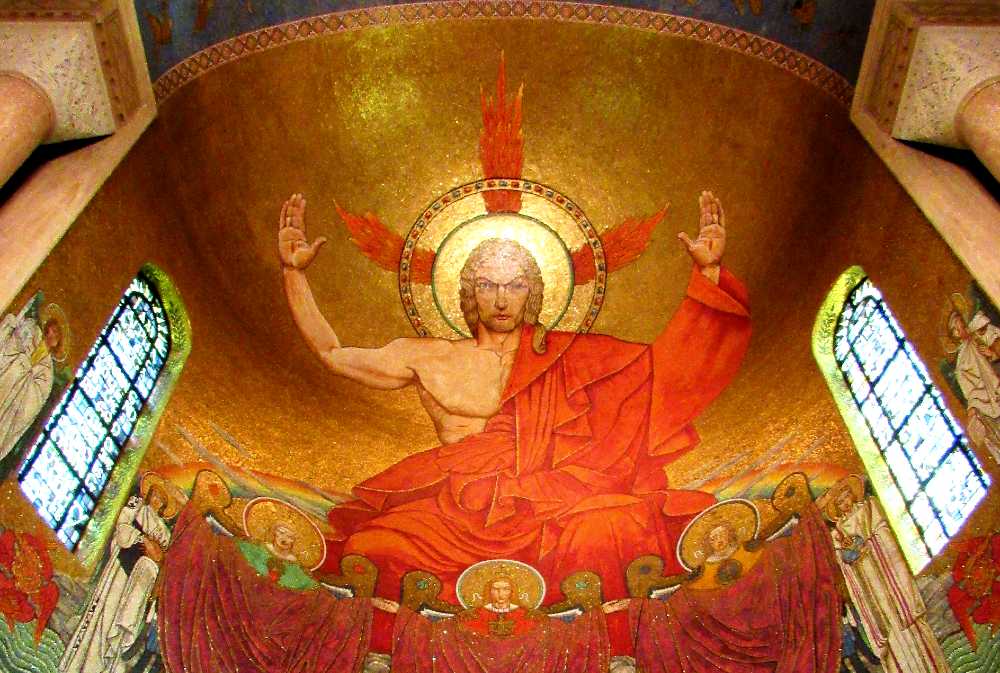
To give you a little perspective, the distance between His outstretched hands in this mosaic is 34 feet. He has columns of fire coming from behind His head that look like three massive solar flares. The golden halo seems to glow white-hot and enshrines a severe face with a knitted brow. He is muscular, and the drapery pulled off His right shoulder reveals the wound in His Heart.
They have named the dome “Christ in Majesty” perhaps to soften the harshness of His look, but there’s no getting around it. The Pantocrator is not the mild and gentle Good Shepherd of the Gospels here. He is the Supreme Judge—an image that would probably make Sgt. Hall very happy.
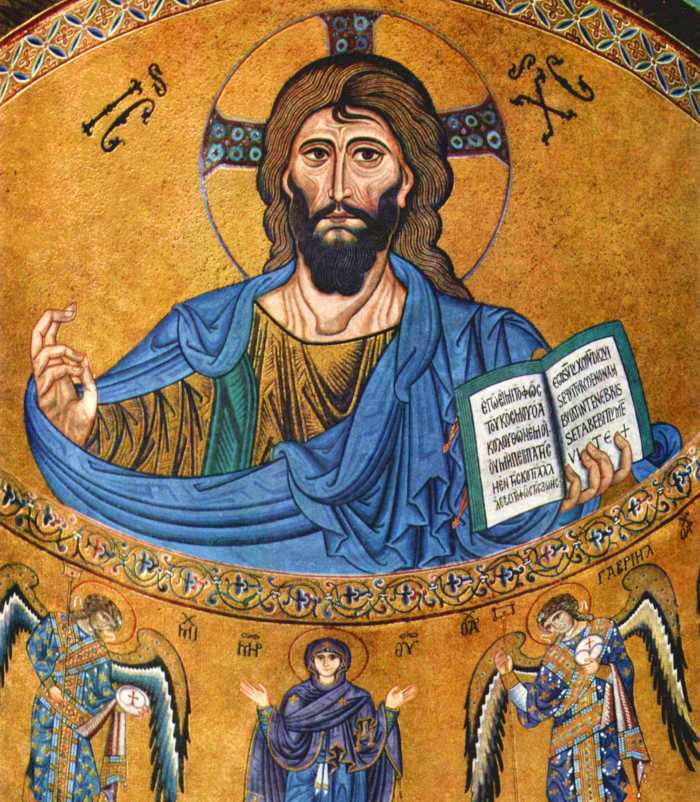
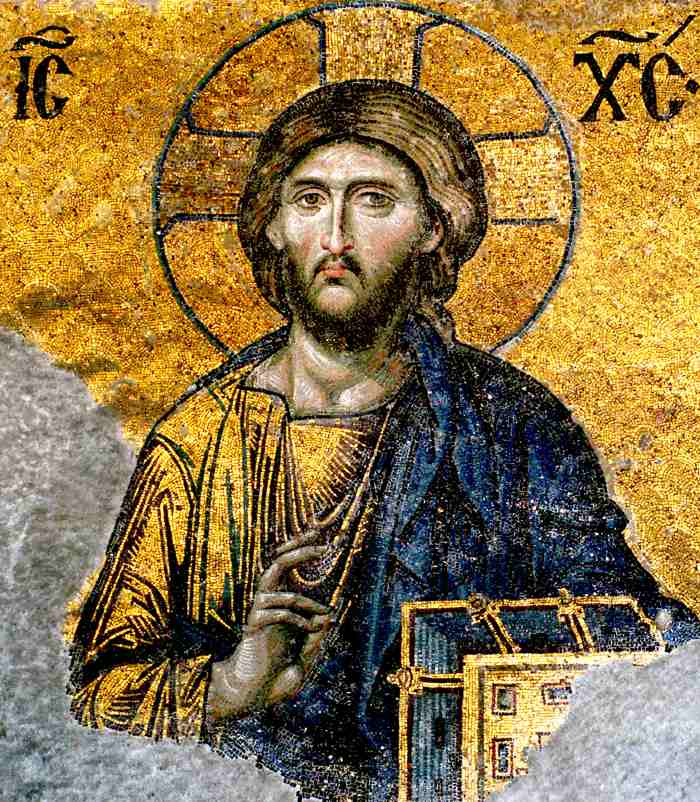
(Left: Cathedral of Cefalù, Sicily. Right: Church of Hagia Sophia, Istanbul Turkey, see full mosaic below.)
Fierce-Looking Lord
Warriors like to look fierce. Their reason is simple: there is a psychological aspect to war. When the stakes are high—in war, it’s a matter of life or death—a warrior cannot be effeminate. He has to be intimidating and ferocious to strike fear into the heart of his opponent and to let the enemy know he means business.
(Image at right: Woodcut of St. Michael battling Satan, by Albrecht Dürer, 1511.)
For that reason, images of the Pantocrator throughout the ages have been rather severe-looking, to say the least. (You’ll see a number images below.) In Revelation, He is depicted as an irrepressible Warrior riding on a white horse into battle. The description is incredible:
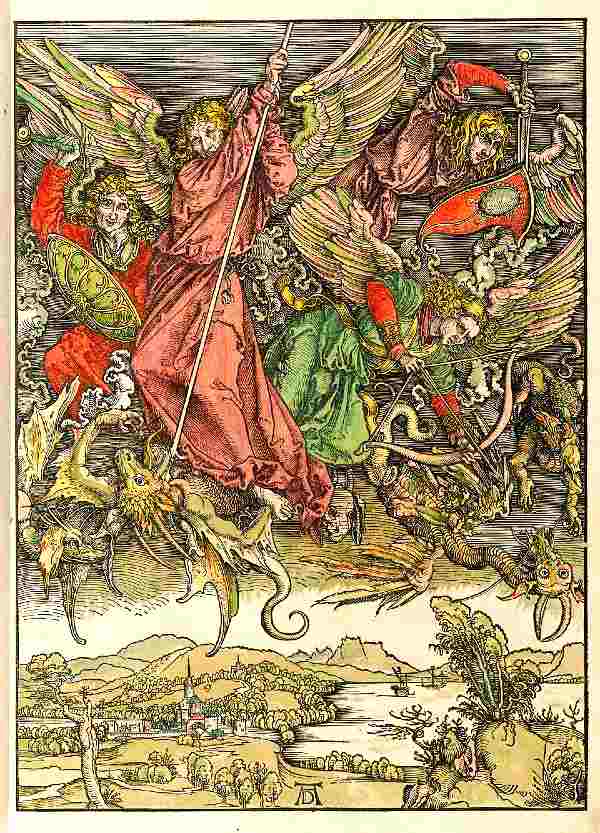
He judges and wages war in righteousness…. His eyes were [like] a fiery flame, and on his head were many diadems…. He wore a cloak that had been dipped in blood, and his name was called the Word of God…. The armies of heaven followed him… Out of his mouth came a sharp sword to strike the nations.
And in one single campaign, the Almighty Lord vanquishes the beast, the false prophet, and the devil “by the sword that came out of the mouth of the one riding the horse” (Rev 19:11-16.21).
Whoever didn’t get the message prior to the Day of Judgment will know, at that time, that the Pantocrator is serious about our salvation.
The Just Judge
I can hear the objection of a soft church now. “Does He have to look so severe?” (Translated into modern terms: like a big meanie).
Well yes, as a matter of fact, He does. And it won’t kill you to see it.
But note this. His look is primarily directed against the one who will, in fact, kill you, eternally: the Evil One and his minions (Rev 12:7-8). And Jesus would like to help you avoid that fate. I’m glad for that. He looks severe because our enemy is severe.
There’s another aspect to it, however. His grim look is a reminder to all human beings, including His allies (us), that we all have a Final Judgment to go through which no one can avoid. Says St. Paul:
“For we must all appear before the Judgement Seat of God” (2 Cor 5:10).
Gulp.
A serious demeanor in confronting ultimate things usually has the effect of waking us up to a reality that we have missed or a point of importance that we cannot afford to get wrong.
The Book of Life
Ever since Christianity was legalized by the Emperor Constantine in 313 AD, Christian churches have been decorated with the image of the Pantocrator. The Greeks (also known as Byzantines) were particularly good at it.
Perhaps the most famous of them all is the image of Christ in the basilica of Hagia Sophia in Constantinople (modern day Istanbul, Turkey). It is based upon a much earlier icon of Christ Pantocrator in the Monastery of St. Catherine in the Sinai Peninsula, Egypt.
A mosaic wall that dates to about 1200 AD contains an image of Christ flanked by the Virgin Mary and St. John the Baptist who are both pleading for sinful humanity before the Just Judge who stands there with His severe look.
He is also pictured holding a book in His left hand (we can only see the top of it due to the degradation of the mosaics). We can still see several bars on it (like locks) which symbolize the seven-sealed Book of Life in Revelation (3:5; 13:8; 17:8; 20:15; 21:27) that only He can open. It contains the names of all who have been saved.
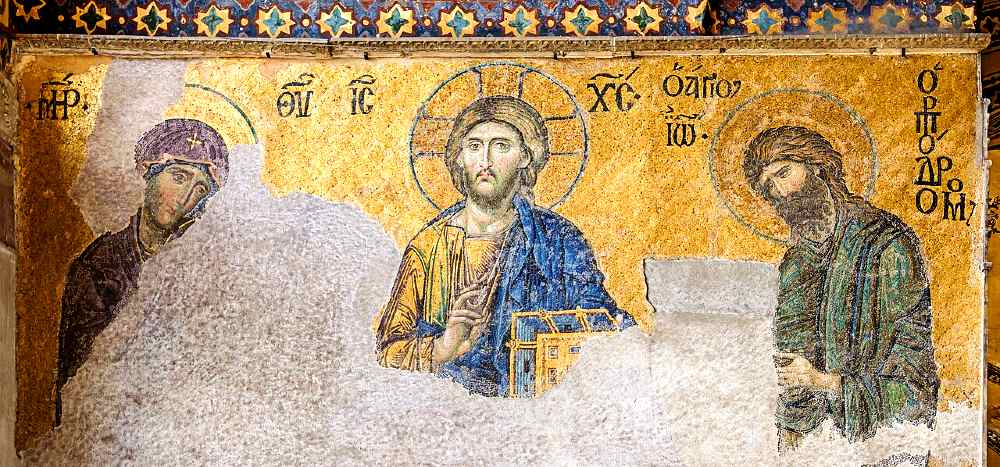
A closer view of this image, however, also highlights another aspect of the severe Christ. Notice that the Judge is not only Justice—by the book, so to speak. He is also Mercy. His hand is raised in blessing because He hears the pleadings of the saints and the Church. The whole mosaic is appropriately entitled “Entreaty” (Deësis in Greek), or as we would say, “Intercession.”
The Pantocrator Images
This beautiful and theologically-accurate iconography is repeated in many images of the Pantocrator throughout the ages. (Interesting that the one in our National Basilica does not show Christ blessing. Hmmm.)
As I said, the Byzantines were extremely adept at crafting this image, so the images below mostly come from Orthodox churches or those in areas influenced by Eastern Christianity, and they are glorious. Here are a few.
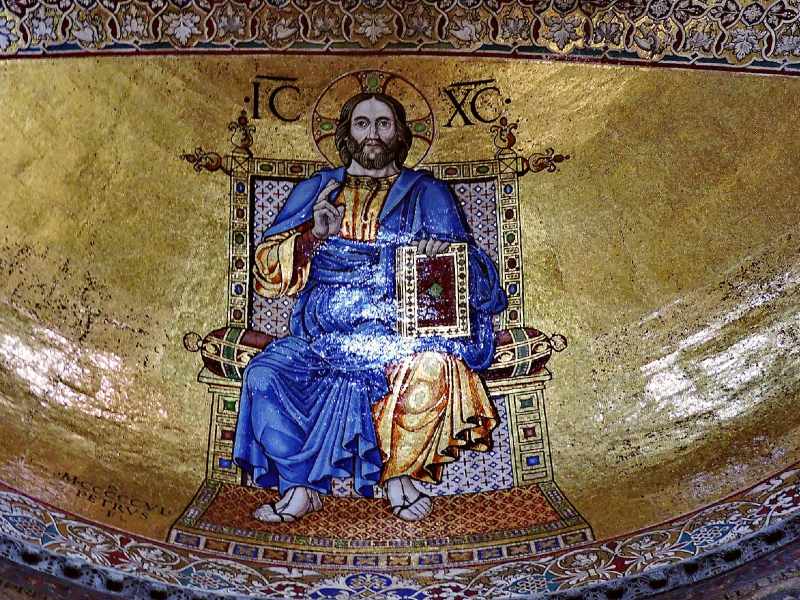
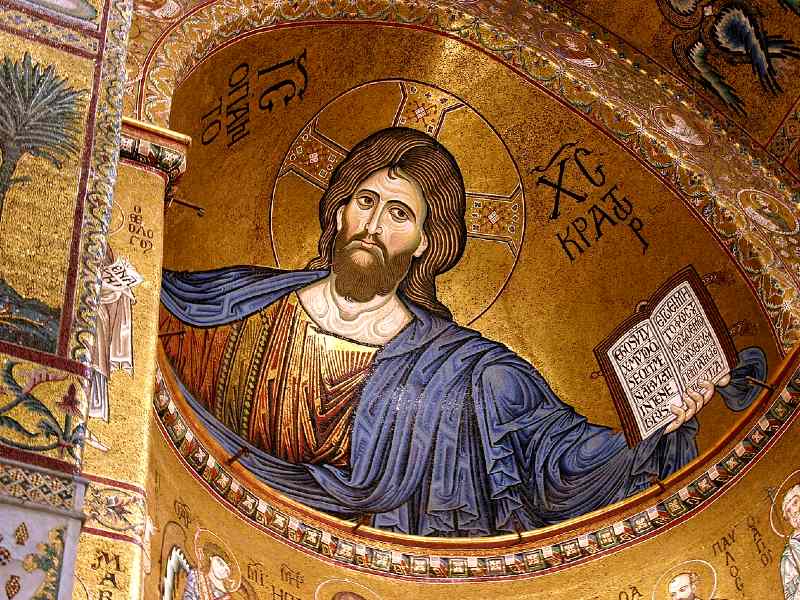
(Left: Basilica of San Marco, Venice, Italy. Right: Cathedral of Santa Maria Nuova of Monreale, Palermo, Sicily.)
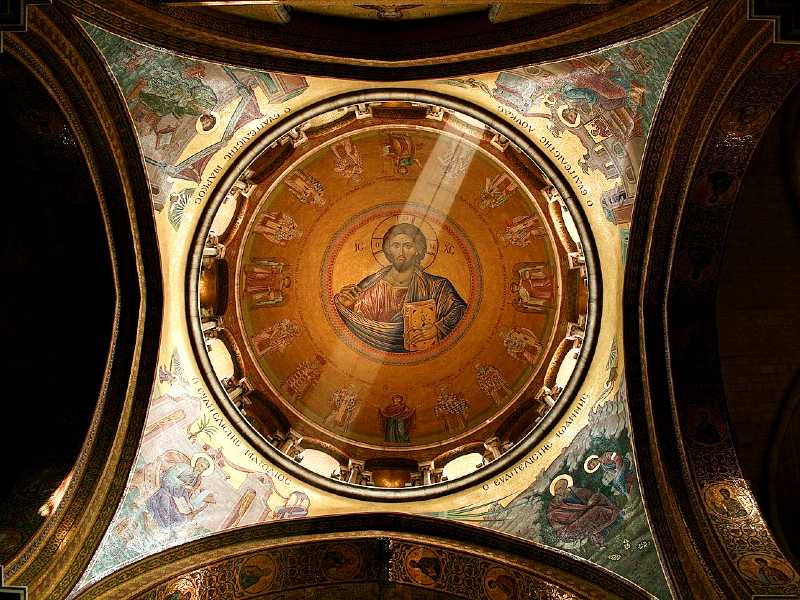
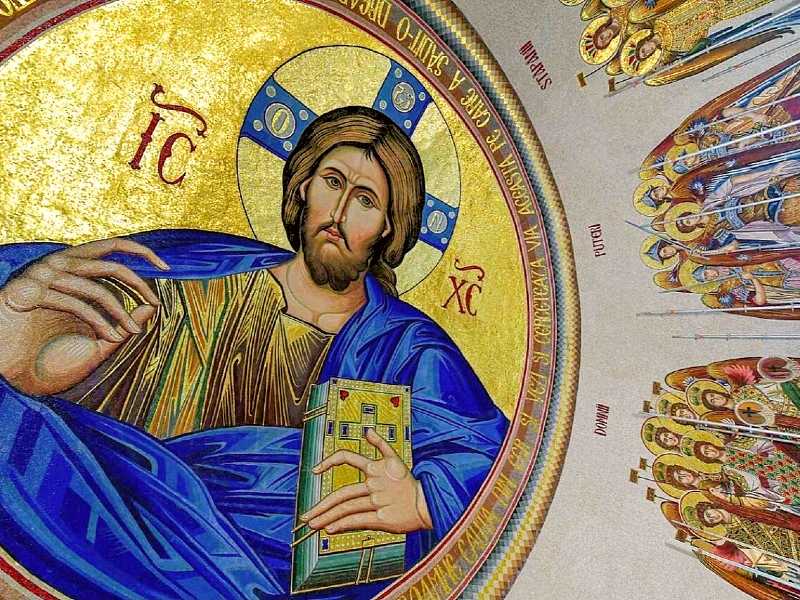
(Left: Church of the Holy Sepulchre, Jerusalem. Right: Cathedral Church of the Redemption, Bucharest, Romania.)
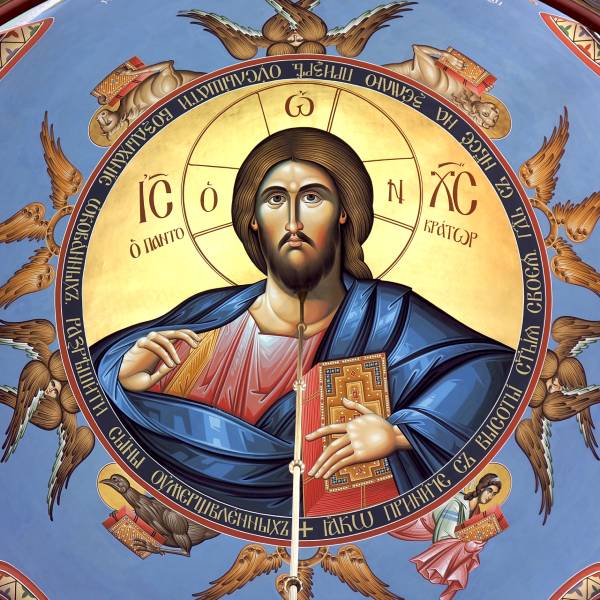
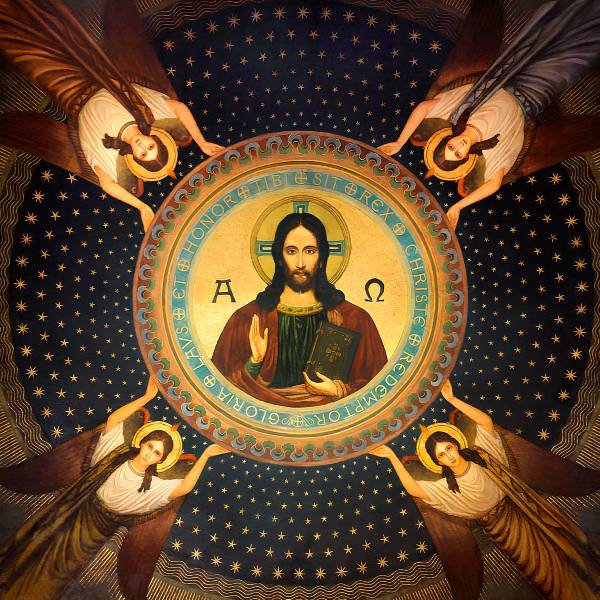
(Left: Church of the Holy Sepulchre, Jerusalem. Right: Cathedral Church of the Redemption, Bucharest, Romania.)
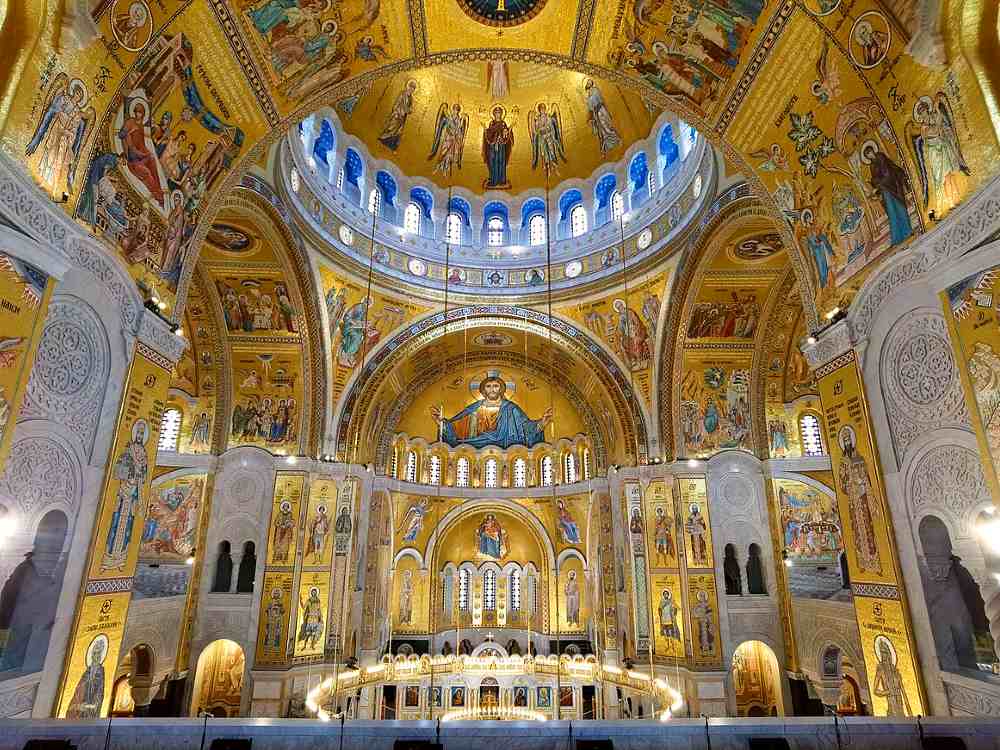
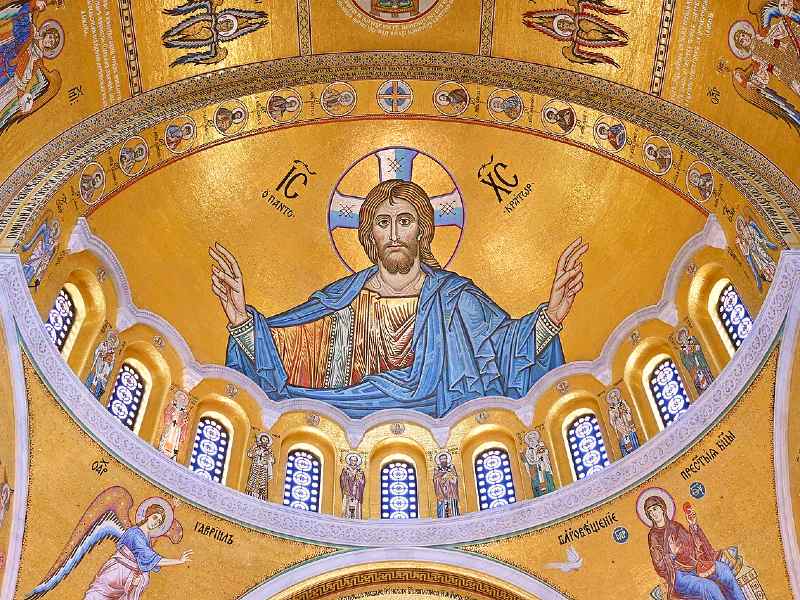
And I’ll leave you with one more magnificent image in its full setting. This is a panorama of the Orthodox Church of St Sava in Belgrade Serbia, where you can see the Pantocrator presiding over the entire heavenly display and blessing the world with both hands. It is glorious!
Our Savior
We have good reason to call Jesus The Almighty, don’t we? He’s been revealed to us in Scripture and Tradition (especially art) as our beloved Savior, the all-powerful God who will eventually come to judge the living and the dead with His eternal Justice and Mercy.
We are warned and chastened by His relentless judgment on the evils of this world, but we are also grateful that He has written our names in His Book of Life.
In other words, He wields real power in the warlike business of crushing evil, and His serious demeanor shows that He’s adamant about the salvation of our souls.
I think I know a Marine Corps drill sergeant who would approve of this message.
—
Photo Credits:
Feature by Pixabay; Clark Kent! (greyloch); Nevsky Church Belgrade (Petar Milošević); St Benedict Monastery, Sao Paulo, Brazil (ViaBarbastro); Santa Pudenzia Mosaic, Rome (Sailko); Deesis Mosaic Hagia Sophia (Myrabella); St Sava Belgrade Panorama (P.Cikovac); St Sava Belgrade Detail (Ivanpancic); San Marco Venice (Dimitris Kamaras); Church of the Holy Sepulchre, Jerusalem (Diego Delso); Monreale, Palermo, Sicily (José Luiz Bernardes Ribeiro); Holy Savior Cathedral, Bucarest, Romania (MIHAIL); Cefalu Cathedral, Sicily (Master of Cefalù); Washington DC Dome, Christ in Majesty (Farragutful); Washington DC, view of nave (w_lemay); Apocalypse (Albrecht Dürer, Houghton Library).
———-
[Note: This article is a reproduction of the Sacred Windows Email Newsletter of 5/17/26. Please visit our Newsletter Archives.]


.jpg)


.jpg)

.JPG)
.jpg)


Leave A Comment