

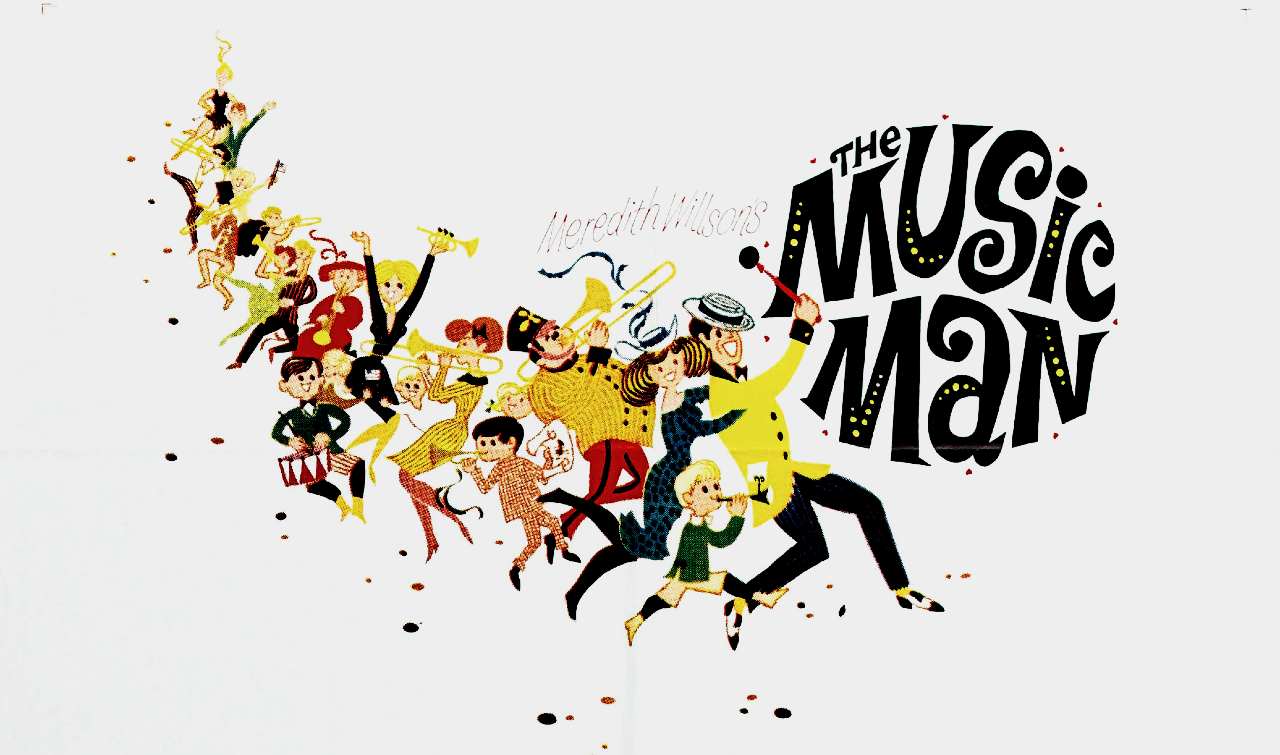
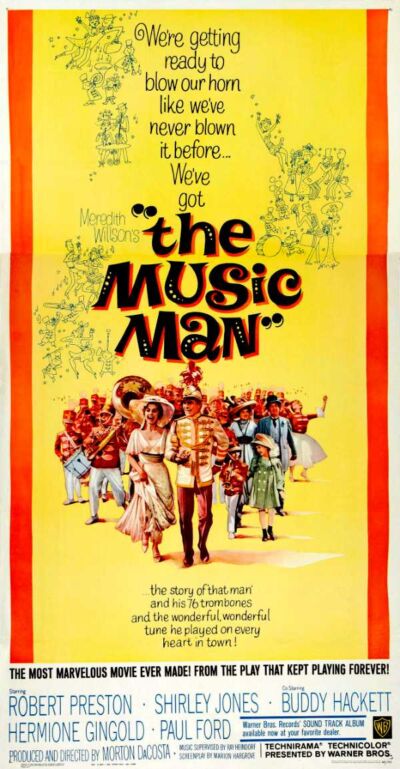
The fabulous 1962 musical, The Music Man, left its mark on American culture and won a place as one of America’s greatest films. Even though the show is a parody, full of subtle clichés and stereotypes, it revealed the depths of simple beauty in American culture in a totally unique way, which is why it was so popular.
Yet, even the stereotypes were so well-crafted they made it feel like an “energetic slice of Americana,” as one writer called it. I call it a sacred window of artistry. It was a stage play later made into a film and easily one of America’s finest productions. We’ll deal here with the film version which is familiar to most Americans.
The Leader of the Band
The lion’s share of the film’s dynamism flows out of the phenomenal talent of the actor who played the lead part on the Broadway show: Robert Preston. But when it 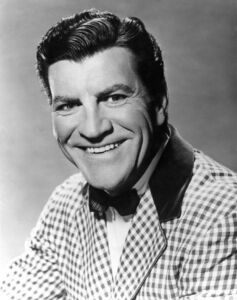 came to the big screen, Hollywood bigwigs almost rejected Preston despite his having played the same part 883 times on Broadway.
They wanted a bigger name, so the part was offered to James Cagney and Bing Crosby, who both turned it down, providentially. They even considered offering it to Sinatra, but they first asked Cary Grant to take the part, and he said frankly that he could not outdo Bob Preston for the role. And furthermore, he added, he would not even go see their movie unless Preston had the lead.
So, the die was cast, and in turn, Robert Preston was cast as the lovable con man, the fake “Professor” Harold Hill whose shenanigans to swindle a small town with his scheme to start a boys’ band made up the plot of the movie. The bigwigs didn’t know it at the time, but the decision to give Preston the lead role literally turned the movie into a solid gold hit from day one. And the rest is history.
 It also didn’t hurt that they cast the golden-voiced beauty, Shirley Jones, as Marian the Librarian. Preston wanted Doris Day to play the part, but Jones won out, and she was perfect. After The Music Man, she went on to play her most beloved role as the mother of The Partridge Family sitcom in the early 70s, which is how most Americans remember her.
“An Energetic Slice of Americana”
The film opened to rave reviews that never seemed to stop. The comment, “an energetic slice of Americana” probably sums up the production’s genius better than any single phrase. A European or an Asian or an African likely would not connect with the symbolism of the movie at all, but Americans of the early 60s sure did connect, even though the story was set in the early 1900s (one line of dialogue in the movie reveals that the year was 1912, and all the costumes and settings reflect the period.)
Although the institutions represented in the film were parodies about small town America, they were also clever and nostalgic at the same time and all of them endearing. They had a ring of truth to them which made them believable. Americans recognized themselves in these characters and wanted to laugh at their own idiosyncrasies. That’s even truer if there’s a happy ending to the story, which there is. More about that below.
A Peek Into Culture
The homey scenarios in the movie form the structure and cultural background of the story. The setting was the fictitious River City, Iowa—population 2,212—that could have represented a thousand rural towns in America at the time. Incidentally, “River City” is the nickname of Mason City, Iowa, the actual hometown of the show’s creator, Meredith Wilson. The river in question is the Winnebago! Accordingly, the movie is full of quaint Americana:
- The typical small town: It had a town square bordered by a church, a library, an ice cream parlor, and a city hall; they were a tight-knit farming community where everyone knew everyone else. Is that a thing of the past nowadays? If nothing else, the small town is a dying breed as America becomes more commercialized and urbanized.
- The con man cometh: The plot wasn’t farfetched in an era when traveling salesmen and roving conmen were likely to swindle you out of a bunch of money. Prof. Harold Hill was the quintessential carpetbagger and confidence man. Nowadays, the cons have just changed venues and tactics. They come at us through phone calls and email scams informing you that your car warranty has expired. Back then, the con had to be more personal and face-to-face.
- The colorful locals: In the film, we meet the farcical group of society ladies, the cutout politician mayor who is the king of malapropisms who is always telling others to “watch your phraseology,” and the officious members of the school board. Small town Iowa is most endearingly portrayed in the fabulously fun song “Iowa Stubborn” which has no equal in the annals of Hollywood creative work, I believe. Remember this one? “We’re so by-God stubborn we can stand touching noses for a week at a time and never see eye to eye.” It’s a pristine caricature of American rural culture, and in my mind, a masterpiece. [See the video below.]
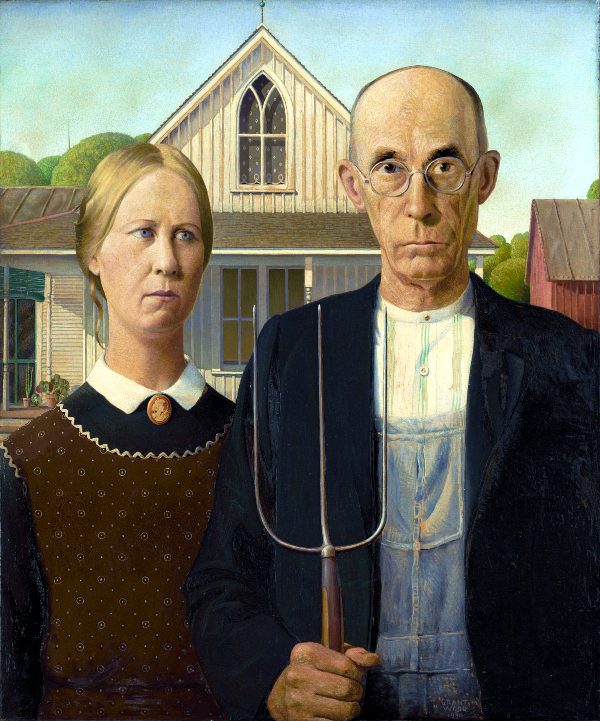
Image above: “American Gothic” by Grant Wood (1930) depicting a farmer and his daughter. The house in the background is a real dwelling in Eldon, Iowa, and the figures are the artist’s sister and his dentist!
- The librarian/love story: The world of 1912 existed before the era of modern communications and even preceded the onslaught of radio and television. It was an era of reading (what a novel idea, pardon the pun), so the small-town library was a respected institution in society. Marian Paroo, the librarian, is probably the only one in the story who isn’t taken in by the cons and charms of Professor Hill…until she is. We all love a love story, and the movie doesn’t disappoint.
- The fabulous music and dancing: Coming right from Broadway, The Music Man is full of both. There is the wonderful barbershop quartet (actually, a national champion foursome called the Buffalo Bills) and plenty of fun virtuoso solos, clever duets, and full cast thrillers that delight the heart and imagination.
- The marching band: This homegrown institution is treated with a reverence that strikes us as unusual because we have so many other forms of entertainment in the modern age, but before the advent of commercialized sports and entertainment, local bands were much more popular. There are references in the movie to famous American bandsmen of the 1800s such as W.C. Handy and John Phillips Souza. Professor Hill pauses and nods his head when he mentions that last sacred name.
- A moral society: Hill is able to manipulate the simple townsfolk precisely because they have a moral code and are concerned about the corruption of their youth. The presence of a new billiard table and pool hall became the foil for his swindle campaign. The pitch is simple and effective: “Idle minds are the devil’s playground.” It’s a parody on the theme, but it isn’t mockery of Christian values either. It’s a self-deprecating kind of fun that every protective parent can relate to in some way.

His Conman Pitch
Harold Hill’s pitch is the bright center of the storyline. He is standing on the platform underneath the bronze statue of the city’s founder and calling all citizens in the square to gather around him to alert them about how their youth are “frittering away” their time fascinated by the new pool table. It’s a serious crisis! His opening pitch urges them to “figure out a way to keep the young ones moral after school.”
And of course, Professor Hill is there with his ready-made answer: they need a boys’ band! His plan is to sell them the instruments and the band uniforms at inflated costs and then skip town with the cash in hand…but they don’t know that yet.
“Mothers of River City!” cries the conman stridently in the town square and soon has a crowd of townsfolk eating out of his hand.
Prof. Hill: “Heed that warning before it’s too late! Watch for the telltale signs of corruption.” He goes on to mention a few of those signs:
- If your son leaves the house and re-buckles his knickerbockers…(dramatic emphasis) below the knee, he might be in trouble. (Alarm bells sound for one couple who caught their son in flagrante delicto.)
- If he has a nicotine stain on his index finger, he might be…gasp…smoking!
- Check to see if he is starting to memorize jokes from Cap’n Billy’s Whiz Bag? (One shocked father pulls that very joke book from his son’s back pocket and wags a scolding finger at him.)
And the parody continues.
Prof. Hill: “Are certain woooords creeping into his conversation …Wooords like…like ‘Swell’?”
When he says “swell,” the crowd in the square chants in an alarmed crescendo: “trouble, Trouble, TROUBLE, Trouble, trouble!”
“Aha!” says Hill, knowing he’s struck a chord. “And ‘So’s your old man!’”
Crowd: “TROUBLE, TROUBLE TROUBLE!!!”
Prof. Hill: “And so my friends, you got trouble / Right here in River City / with a capital T that rhymes with P that stands for “Pool” …that game with the 15 numbered balls is the devil’s tool.”
I’ve condensed the whole scene into a few lines, but there’s nothing like the four-and-a-half-minute routine [see the clip below] that is Broadway/Hollywood at its finest. As I mentioned above, the scene is carried by the sheer virtuosity of Preston’s voice and charisma.
Pure Artistry
But it’s only one of many wonderful elements of the storyline and music of Meredith Wilson. In fact, there are so many memorable songs in this show, it’s a literal embarrassment of riches. In addition to “Iowa Stubborn” and “Trouble in River City,” most Americans will remember a host of other delights from this film:
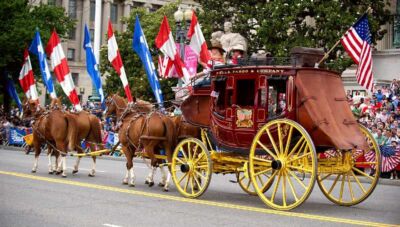
- “The Wells Fargo Wagon” | “Seventy-Six Trombones” | “Pick-a-Little, Talk-a-Little.”
- Harold Hill’s ditty about his hometown “Gary, Indiana” and “The Sadder but Wiser Girl.”
- The Buffalo Bills’ four-part harmonies in “Ice Cream,” “Sincere,” “Goodnight Ladies,” and the unforgettable “Lida Rose.”
- Several sad but hopeful love songs provide a serious romantic undertone to the whole show as we realize that Marian the Librarian and the slick conman are actually falling for one another over the course of the drama. Marian sings:
- “Goodnight, My Someone”
- “Being in Love”
- And the immortal, “Till There Was You,” a song that was so popular that it was even remade by the Beatles in 1963.
Wilson’s particular genius was his ability to meld these different feature pieces into beautiful duets. The sequence always went this way: one person or group would sing their song, followed by the second person or group singing another song, followed by the two groups singing their songs as if riding a tandem bike.
It’s only then that the viewer realizes that the songs were actually composed as combos to be sung together to brilliant effect. [See the “Lida Rose / Will I Ever Tell You?” combo in the clip below.]
All’s Well that Ends Well
The only thing Americans love more than an underdog or come-from-behind victory story is the proverbial happy ending, where all crises are resolved and everyone goes away exuberantly happy. That’s especially true if the plot carries a twist at the end that makes everything work out. The Music Man doesn’t miss a beat there either.
When Harold Hill’s con is finally outed by a traveling anvil salesman who brings letters from previous victims of the fake professor, the town rises up against the conman and leads him off to be publicly humiliated in a town hall meeting. The guilty verdict was to be followed by the inevitable tar and feathering as a punishment for his scam.
But…when the professor is finally in handcuffs and about to be condemned, an astonishing thing happens.
A whistle blows and a cute little hometown band comes marching into the hall to play their music, which even Harold Hill didn’t think was possible. The professor, while still in handcuffs, was forced to get up and direct the fledgling band without much hope that the slightest musical sound would emerge.
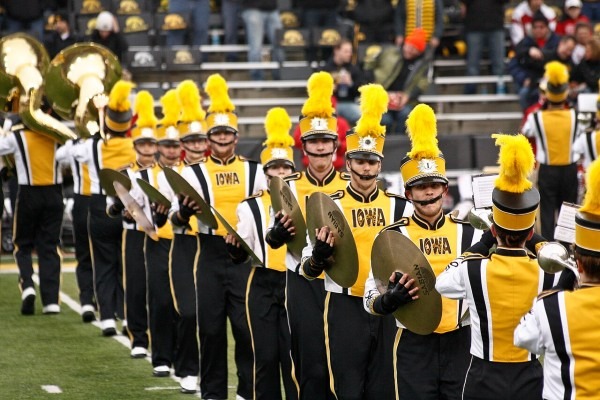
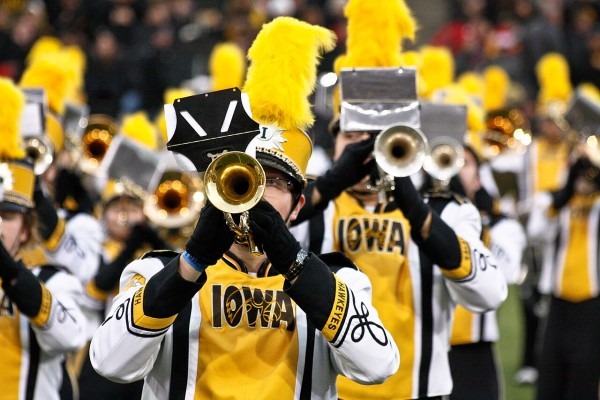
Featured above are images of the Iowa State Buckeye Band. In the film, the scene was performed by the USC marching band in bright red uniforms.
 Then, to everyone’s surprise, the little band played—a completely awful performance—that was punctuated by hometown mothers and fathers standing up and yelling, “There’s my boy playing the clarinet!” and so forth. Well, the reversal of emotions that took place at that moment in the group of angry Iowa farmers was astounding. Anger turned to raucous joy! It was a plot twist extraordinaire.
Harold Hill was vindicated because the boys actually did form a band, quite despite his attempted con. Miss Marian was vindicated in her trust of the conman-turned-hero. And the townspeople were vindicated by the heroics of their own boys who stepped up to the plate and gave the performance of their lives after only a few short weeks of practice.
And then the final transformation. In the closing scene, a brightly-uniformed and well-trained marching band parades down Main Street to the acclamations of the whole town clapping and cheering. They were playing “Seventy-Six Trombones” with Robert Preston marching exuberantly in front of them as the Music Man extraordinaire in full regalia.
One can’t help but agree with the writer who said that there’s simply nothing like that delightful “energetic slice of Americana.”
Featured Videos
Iowa Stubborn
Ya Got Trouble
Lida Rose
———-
Photo Credits: Feature image via Wikimedia: Trumpeter (C.lettinga, CC 2.5); Robert Preston (public domain); Shirely Jones (Partride Family, ABC); Wells Fargo Wagon (SSG Teddy Wade, Public domain); Billiard balls (Andrzej Barabasz); Grant Wood American Gothic (public domain); Film Poster 1 (1962 Warner Bros., public domain); Film Poster 2 (Bill Gold, Public domain); Hawkeye Band (Phil Roeder, 1 and 2).
———-
[Note: This article is a reproduction of the Sacred Windows Email Newsletter of 8/23/26. Please visit our Newsletter Archives.]




.jpg)


.jpg)
.jpg)
.jpg)
.jpg)
Leave A Comment